
Direct answer
How should AI content services be packaged?
Package AI content services around a defined client outcome, not around access to a generation tool. Choose one production lane, specify required inputs, exact deliverables, approval gates, revision limits, usage terms, exclusions, and handoff files. Price and present the engagement as a bounded system—such as a product-visual sprint, UGC concept pack, or campaign asset system—so the buyer can judge what will be delivered.
This is an operating framework for scoping creative work, not a pricing guarantee or legal template. Commercial terms should be reviewed for the actual client, market, and usage.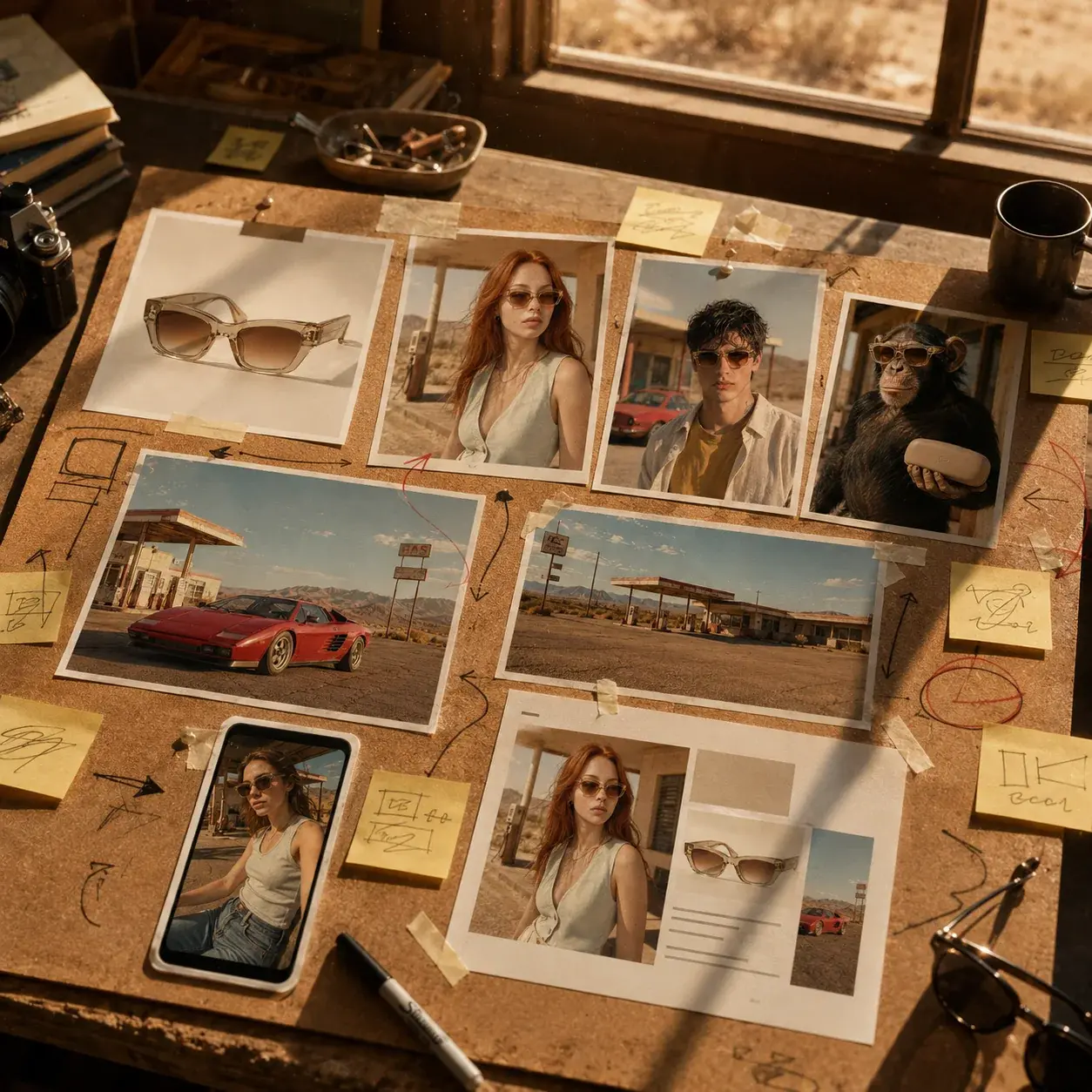
Proof-to-offer example
Different proof demonstrates different production capability.
The Ford GT study demonstrates master-frame consistency and motion direction. Desert Eyewear demonstrates product-to-campaign expansion. The creator study demonstrates identity, product integration, and UGC performance. A relevant portfolio shows the system closest to the client’s problem.
Inspect the complete case studyThe referenced work is clearly labeled spec production, not presented as commissioned client results.Clients do not buy prompts
A client buys launch assets, ad concepts, product images, creator directions, or a repeatable internal system. The AI tools are part of delivery, not the headline of every offer.
Build a bounded offer
A narrow sprint is easier to price, sell, and deliver than an undefined promise to make content.
- Problem: the specific creative bottleneck the sprint solves.
- Inputs: product photos, references, brand assets, and approvals required.
- Deliverables: exact asset count, formats, and documentation.
- Process: concept directions, selection point, refinement, and handoff.
- Boundaries: revision rounds, usage, excluded work, and timeline.
Proof should mirror the offer
A cinematic car edit proves visual craft, but it does not automatically prove UGC strategy. Organize proof by client problem so the buyer can recognize the outcome they need.
Choose a production lane before choosing a price
A product-visual sprint, creator-led UGC concept pack, short-form motion system, and reusable prompt system solve different problems. Define the buyer, bottleneck, inputs, production method, deliverables, and selection gate for one lane before combining services.
Per-asset pricing can fit repeatable outputs with stable inputs. A sprint can fit a bounded concept and delivery cycle. A retainer can fit recurring production only when volume, approvals, revision boundaries, and turnaround are predictable. The structure should follow delivery risk rather than a fashionable pricing model.
Set expectations before generation
Explain which source assets the client must authorize, which details AI may struggle to preserve, where human selection and repair are included, and what counts as a revision. Separate a new creative direction from a correction inside an approved direction.
Agree on final formats, source-file handoff, prompt documentation, usage, confidentiality, synthetic-media disclosure, likeness, music, trademarks, and excluded work. Use qualified legal advice for contracts and rights questions.
Build a portfolio around buyer decisions
Show the brief, fixed references, approved direction, connected outputs, failure controls, and final deliverable set. Label spec work honestly. A buyer should understand not only that the images look strong, but how the production system reduces ambiguity and creates the formats they need.
Do not attach performance claims to visual proof unless real campaign data is available and attributable. Production quality and advertising performance are related questions, not interchangeable evidence.
Diagnostic table
Find the failed layer before regenerating.
| Visible signal | Likely cause | Controlled correction |
|---|---|---|
| Prospects ask only for a cheap image | The offer is described as tool access or asset count | Lead with the production problem, system, and delivery outcome |
| Revisions expand without control | Selection gates and direction changes are undefined | Separate concept selection, refinement, and new direction requests |
| Portfolio gets praise but few relevant inquiries | Proof does not match the service being sold | Organize cases by buyer problem and deliverable system |
| Projects become unprofitable | Input quality, repair risk, handoff, or usage was not scoped | Price after documenting constraints and production risk |
Production checklist
Approve the system, not only the best frame.
- One buyer, bottleneck, and production lane are named clearly.
- Required references, brand assets, approvals, and usage information are listed.
- Deliverable counts, formats, handoff files, and exclusions are explicit.
- Concept selection, included refinement, and new direction requests are separated.
- Usage, likeness, disclosure, music, trademarks, confidentiality, and ownership are addressed.
- Portfolio proof is relevant, honestly labeled, and free from unsupported performance claims.
Frequently asked
Questions this workflow should answer.
How should AI creative services be packaged?
Package one client outcome with defined inputs, deliverables, approval stages, revision boundaries, usage, exclusions, and handoff. The tools are part of delivery, not the complete offer.
Should AI content services be priced per asset or as a package?
Use the structure that matches production risk. Per-asset pricing fits stable repeatable outputs; a sprint fits a bounded concept cycle; recurring work needs predictable volume and approvals before a retainer is sensible.
Can spec work be used in an AI creative portfolio?
Yes, when it is clearly labeled and does not imply a client relationship, endorsement, campaign performance, or rights that do not exist. Explain the brief and production system the work demonstrates.

Written from production practice
Omer Faruk Sahin
Founder, CEO, and Creative Director at AI Craft Academy. Omer leads strategy, product, advertising, creative direction, and the production systems documented in these field guides.
Founder profileContinue building
Learn the complete production workflow.
The Academy connects prompt structure to references, first frames, motion, editing, distribution, and monetization.
Explore the Academy