
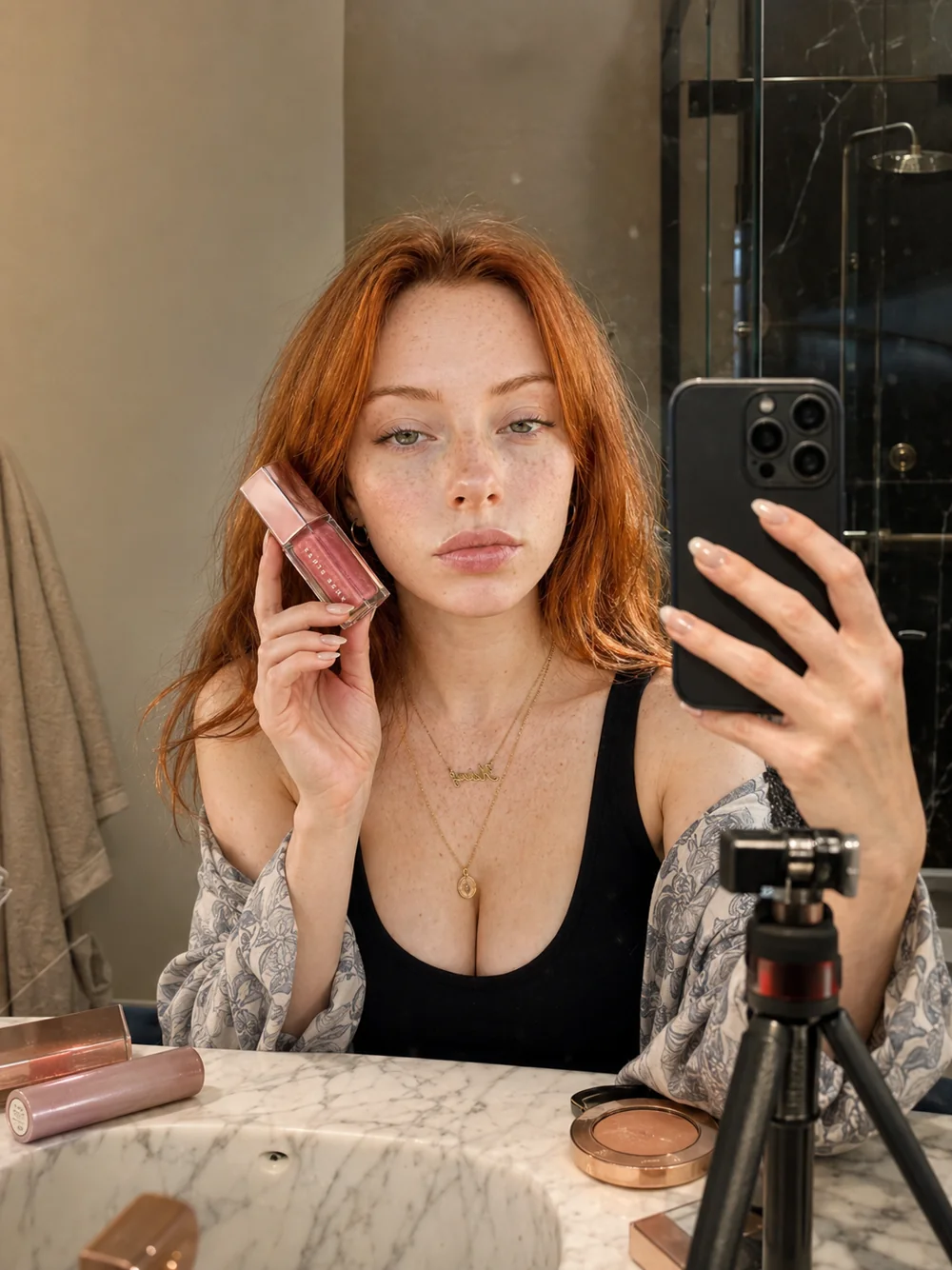
Fictional planning example
Fictional moisturizer demonstration
A fictional creator introduces an unbranded moisturizer using a stable hold, one pump action, and a separate texture close-up.
This example is fictional and demonstrates planning structure only. It is not a client campaign, testimonial, or performance result.Step-by-step workflow
AI UGC product handling guide: the working sequence.
- Choose one product fact the shot must communicate.
- Select one physically simple action.
- Lock grip, label orientation, and camera distance.
- Separate dialogue timing from the action cue.
- Check hands, packaging, contact, and implied claims.
Quality framework
Acceptance checks for AI UGC product handling guide.
- The product remains identifiable.
- One action can finish in the shot.
- Hands do not obscure required text.
- Dialogue does not overclaim the visual.
- The next cut has a clear continuity anchor.
Example deliverables
Outputs from Fictional moisturizer demonstration.
- Hold frame
- Single-action demo shot
- Texture insert
- Claim-safe script note
Common mistakes
Failure modes specific to AI UGC product handling guide.
- Requesting several hand actions at once
- Turning the label away from camera
- Using dialogue as unsupported proof
- Changing grip between connected shots
Cluster pathway
Choose the next useful step.
Questions
Questions before applying AI UGC product handling guide.
01What inputs should be ready for AI UGC product handling guide?
Prepare approved product views, the one fact each shot must communicate, permitted claims, creator direction, and the final phone-native crop.
02What uncertainty remains after applying AI UGC product handling guide?
It helps direct believable product interaction without overloading a generated shot. It cannot guarantee output quality, commercial performance, or a business result because references, tools, execution, distribution, and review remain variable.
03Should AI UGC product handling guide be learned internally or scoped with the Studio?
Learn the method through the Academy when the goal is internal capability. Use the Studio when a brand needs the same production decision applied to approved inputs and bounded deliverables.