
Direct answer
The production principle.
A strong AI video first frame is an approved still that already resolves subject identity, geometry, contact points, lighting, camera position, and the space needed for the planned action. Build and compare alternate stills first; move to image-to-video only after the selected frame can stand on its own.
The first frame does not guarantee a clean animation, but it removes defects that motion generation would otherwise inherit or expose. Review it as a production input, not simply as an attractive image.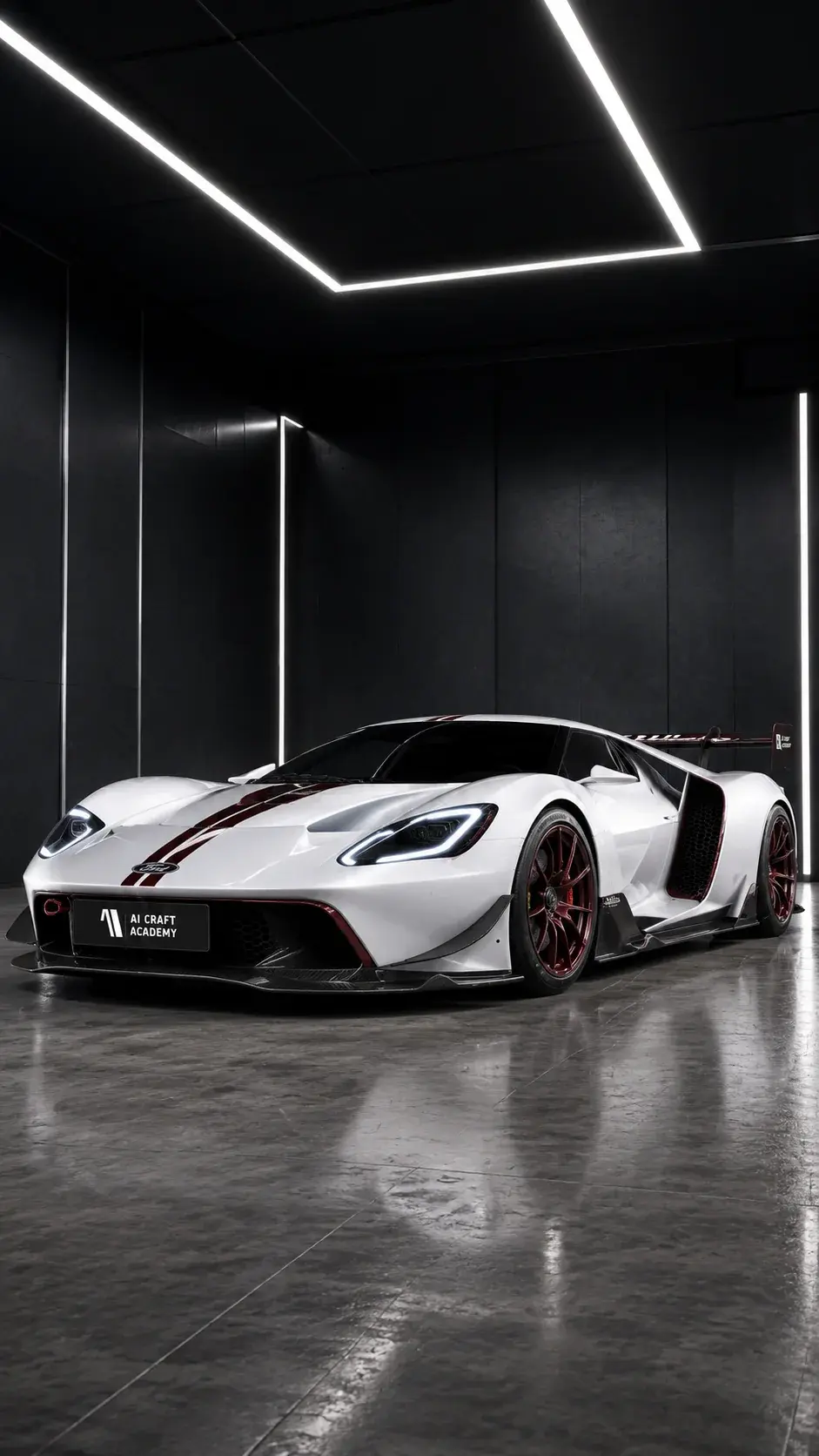
First-hand production proof
One approved Ford GT master became the still-image anchor.
The white body, burgundy center stripe, carbon aero, wheels, studio architecture, lighting geometry, and branded surfaces were locked in one master before front, rear, side, high-angle, macro, and detail compositions were built from it.
Inspect the complete case studyThis is an unofficial AI-generated automotive spec concept. AI Craft Academy is not affiliated with or endorsed by Ford Motor Company.The first frame is a production decision
An image can be visually impressive and still be a poor starting point for video. If the subject is pressed against the edge, the hands are hidden, the product label is already distorted, or the camera angle leaves no room to move, animation usually amplifies the problem.
A useful first frame establishes the approved identity, body geometry, environment, light direction, lens position, and space required by the next shot.
A first-frame approval checklist
Review the frame as if it were the first shot of a real production, not the final image of a prompt experiment.
- Identity: face, product, vehicle, wardrobe, and branded details are already correct.
- Action space: the subject has room to walk, turn, reveal, reach, or interact.
- Camera space: a dolly, orbit, crane, or slider move will not expose missing scenery immediately.
- Continuity: reflections, shadows, contact points, and object scale are believable.
- Edit value: the composition has a clear role in the final sequence.
Add a motion-qualification gate
Still approval answers whether the frame is visually and structurally correct. Motion qualification asks a different question: does that accepted frame preserve identity, product shape, contact, depth, and background structure when one simple movement begins? Run the shortest, least complex proof that can reveal those weaknesses before expanding a full shot family.
A failed motion proof does not automatically mean the tool is unsuitable. It may show that the crop, hidden geometry, action space, or camera request places too much pressure on this source. Return to the still or simplify the intended move based on the first failed layer.
Use draft settings to answer draft questions
Higgsfield's current WAN Camera Control tutorial recommends checking camera behavior, focus, and pacing at a lower-cost setting before committing to a higher-resolution render. That is vendor guidance reviewed on 2026-07-19, not an AI Craft benchmark, and the available settings may change.
The broader production rule is stable: use the least expensive test that can answer the current question, then repeat identity, product, texture, and export review at the final setting. A draft that proves movement does not automatically prove delivery detail.
Generate alternate frames before alternate videos
Image generations are usually cheaper and easier to judge than video generations. Solve the angle, crop, expression, product orientation, and negative space in stills first. Animate only the frames that already satisfy the shot brief.
Motion readiness
Source-frame Readiness Board
Score the still against the exact movement planned for the next shot. A beautiful image is not ready when the motion would expose missing geometry, unstable contact or an unfinished environment.
| Readiness gate | Ready evidence | Repair before motion | Reduce the motion when | Reject the source when |
|---|---|---|---|---|
| Identity and geometry | Face, product, vehicle, wardrobe and structural edges match the approved source. | Correct drift, warped edges and unreadable fixed details in the still. | The subject is accurate but the planned turn would reveal unverified structure. | The starting identity or primary object is already wrong. |
| Action space | Clear frame area exists in the direction of the subject action. | Recompose the crop and remove obstacles from the movement path. | The available space supports only a smaller reach, turn or translation. | The action begins or ends outside any plausible continuation of the frame. |
| Camera space | Background, floor, horizon and lighting can continue through the intended move. | Extend or rebuild the environment before requesting a dolly, orbit or crane. | A locked or subtle camera keeps the approved world intact. | The move depends on scenery or surfaces that the source never defines. |
| Contact and occlusion | Hands, feet, wheels, product bases and overlapping edges have believable contact. | Repair intersections and make critical joints or contact points readable. | The interaction can be simplified without losing the shot's purpose. | A hidden or broken contact point is central to the requested action. |
| Light and reflections | Key direction, practical lights, cast shadows and reflective surfaces agree. | Resolve contradictory highlights, shadows or mirrored content in the still. | A restrained motion avoids exposing unresolved reflective geometry. | The lighting logic changes across the subject before motion starts. |
| Edit role | The frame has one named function and differs from adjacent planned shots. | Reframe it for the hook, reveal, proof, detail, transition or close it must serve. | A shorter or simpler clip still fulfills the assigned edit role. | The frame duplicates another shot and adds no usable sequence value. |
Design the frame around the intended action
Write the planned action and camera direction before composing the still. A turn, reach, reveal, lateral move, or push-in needs a different crop and different clear space. The subject should not begin where the action is supposed to end.
Check what a wider or shifted view could reveal. Background structure, floor contact, reflections, and practical light sources should continue beyond the subject instead of ending at the crop. This gives the approved still a coherent visual world for the next production stage.
- Name one subject action and one camera intention.
- Leave clear space in the direction of the action.
- Keep hands, wheels, products, and other critical geometry readable.
- Confirm that background and surface cues continue beyond the subject.
Approve a still family, not unrelated hero images
Alternate angles should inherit the same subject specification and environmental anchors while serving different shot functions. Compare silhouette, materials, proportions, light direction, surface contact, and branded details across the set before selecting any frame for motion.
In the Ford GT study, the master acted as a reference for distinct front, rear, side, high-angle, macro, and detail views. The angles changed; the vehicle specification and studio logic remained the review standard.
Sources and methodology
Official context, independently organized.
Official Higgsfield education was reviewed to understand how its current tools frame source images, motion, and draft iteration. AI Craft Academy's first-frame qualification gate is an independent production framework. No affiliation or endorsement is implied, and the cited settings were not independently benchmarked across models.
- First and Last Frame TutorialOfficial Higgsfield YouTube video · Published 2026-03-01 · Relevant sections 00:31, 01:25 · Reviewed 2026-07-19
Public metadata and chapter labels were reviewed for source-frame setup; transcript coverage was unavailable.
- Pipeline IntroductionOfficial Academy lesson · Publication date not listed · Reviewed 2026-07-19
Reviewed for the role of controlled inputs within a wider production pipeline.
- WAN Camera ControlOfficial Academy tutorial · Published 2026-06-29 · Reviewed 2026-07-19
Reviewed for its public source-image requirements and draft iteration recommendation; current UI and settings may change.
Diagnostic table
Find the failed layer before regenerating.
| Visible signal | Likely cause | Controlled correction |
|---|---|---|
| Subject is crowded against an edge | The crop was chosen for the still without accounting for the planned action | Widen or shift the composition and leave space in the action direction |
| Contact points or geometry are unresolved | Hands, wheels, product bases, or intersecting surfaces were accepted too early | Repair or regenerate the affected still before considering motion |
| Alternate stills feel like different locations | Environmental anchors and light direction were not carried from the master | Reuse the approved reference and restate the fixed set cues for each angle |
| A branded surface is unreadable | Angle, glare, depth of field, or surface perspective obscures the mark | Solve the branded plane in the still or plan a finishing pass before animation |
Production checklist
Approve the system, not only the best frame.
- Identity, product, vehicle, wardrobe, and other fixed details match the approved reference.
- Hands, wheels, edges, contact points, reflections, and shadows are structurally believable.
- The crop leaves room for the named subject action and camera intention.
- Lens position, horizon, light direction, and environmental anchors agree across alternate stills.
- Logos, labels, and other critical surfaces are readable at the selected angle.
- The frame has a defined function in the shot list rather than duplicating another hero angle.
Frequently asked
Questions this workflow should answer.
What makes a good first frame for AI video?
It is a structurally sound still with approved identity, geometry, lighting, camera position, environmental continuity, and enough space for the intended action.
Should alternate angles be generated before video?
Usually, yes. Still comparisons make it easier to find drift in shape, materials, lighting, contact, and composition before adding motion as another variable.
Does a perfect first frame prevent video artifacts?
No. It removes avoidable source-frame problems, but the motion prompt, model behavior, shot length, and edit still need separate control.

Written from production practice
Omer Faruk Sahin
Founder, CEO, and Creative Director at AI Craft Academy. Omer leads strategy, product, advertising, creative direction, and the production systems documented in these field guides.
Founder profileContinue building
Learn the complete production workflow.
The Academy connects prompt structure to references, first frames, motion, editing, distribution, and monetization.
Explore the Academy