Master environment
No image references. Generate and approve the physical world before introducing talent or product.

Reference-to-motion breakdown
One AI character, one AI environment, and one real garment became a consistent set of campaign stills and controlled three-second motion shots.
Unofficial creative concept produced for educational and portfolio purposes. This project is not affiliated with, endorsed by, sponsored by, or commissioned by Stone Island® or any associated entity.
Why this matters
Most AI campaigns break after the first image: the face changes, the product drifts, the location resets, and the light no longer belongs to the same shoot.
This production separated the fixed layers—identity, garment construction, environment, light and grade—from the variables that should change: shot size, camera position, action and editorial function.
The exact prompts below are production records, not universal guarantees. Reference quality, model versions, output selection and post-production still matter.
01 — The inputs
02 — Reference setup
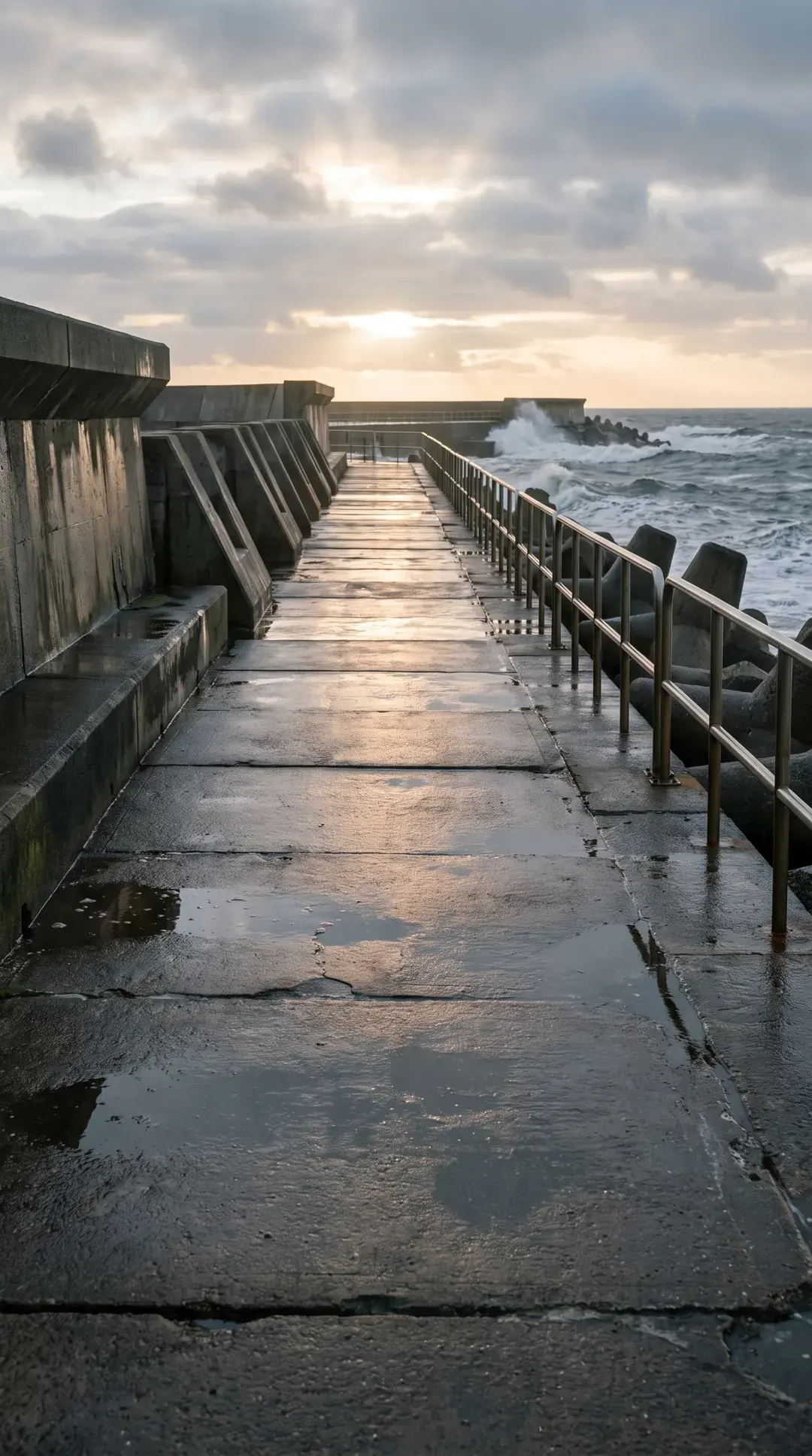
No image references. Generate and approve the physical world before introducing talent or product.
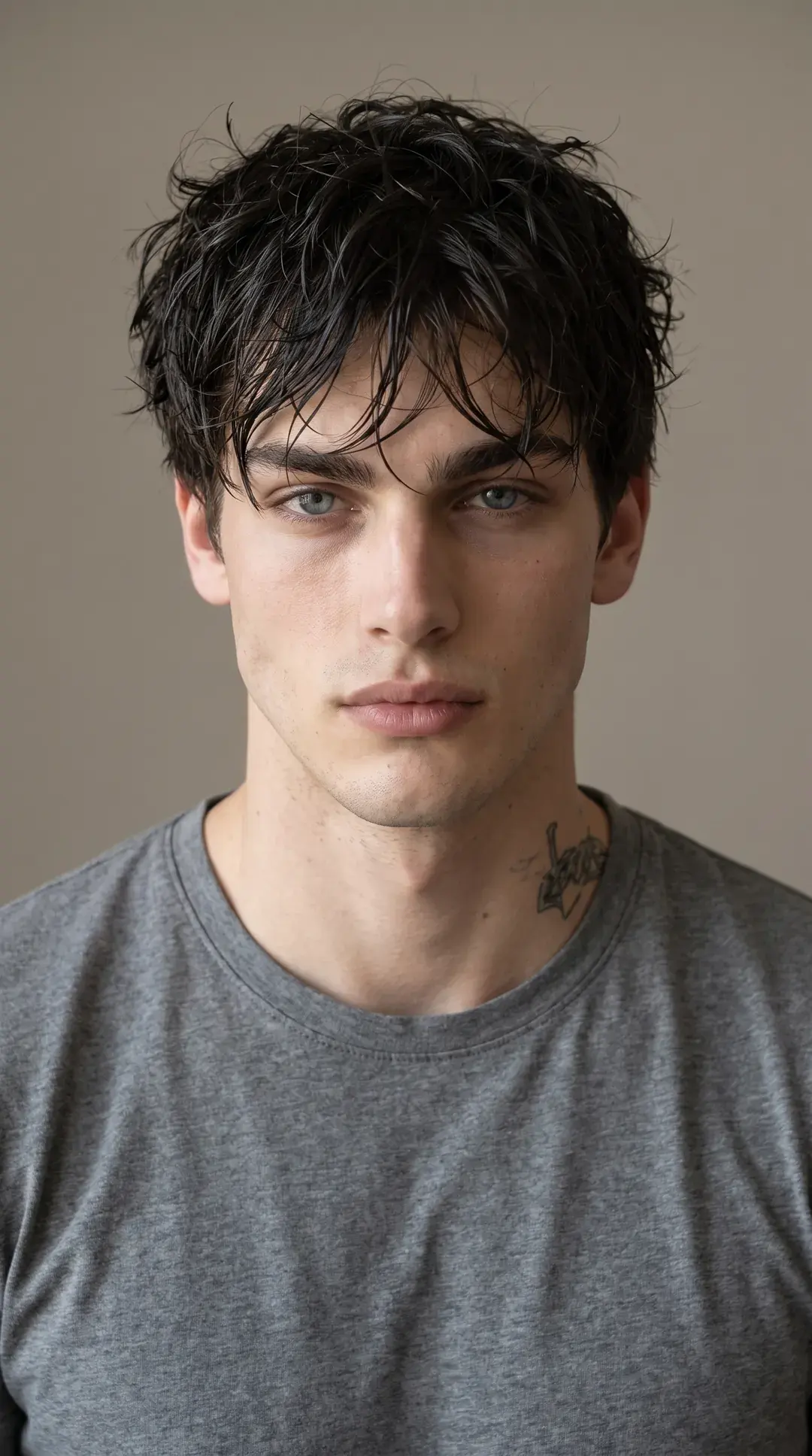
Use the uploaded portrait as the sole identity source. Neutralize wardrobe, pose and background.
Character + product front/back/detail + master environment. Do not expand until this frame works.
Add the successful anchor hero to the same controlled source set. Avoid feeding every previous output back into the model.
Create a premium vertical 9:16 master environment image for a high-end fashion campaign set immediately after a coastal storm. Show a real brutalist seafront breakwater or sea-defense promenade at the edge of a cold northern or Atlantic-looking coastline, photographed as a physically believable place rather than a conceptual set.

The environment must include a wide open concrete walkway or platform built from large poured-concrete slabs, several monolithic wave-break or sea-defense forms, one or two heavy cast-concrete walls, stainless-steel or galvanized metal railings, shallow rain puddles gathered in natural depressions, darkened wet concrete surfaces, subtle salt streaks, runoff stains, and minor weathering from repeated exposure to sea air. The space should feel empty, strong, wind-exposed, and architecturally minimal.

The sea is grey-blue and slightly rough but not apocalyptic. The sky is overcast with a broken cloud layer and one subtle opening allowing low late-afternoon sunlight to skim part of the scene. The light should create a refined contrast between cool ambient storm light and a narrow band of warm post-storm illumination. The horizon must remain straight and believable. The location should feel like a real place used by walkers and maintenance crews, not an abandoned ruin and not a futuristic CGI plaza.

The camera should be placed at approximately 90 centimeters above the wet ground, using a full-frame 55mm-equivalent lens. Do not use a drone angle, top-down perspective, extreme wide-angle lens, or an exaggerated cinematic viewpoint. Preserve natural perspective, realistic spatial depth, and a campaign-photography feel. Reserve an open central path or open concrete staging area where a male model can later be placed naturally. This open area must feel functional and architecturally logical, not blank for compositing.

The surface details must carry restrained realism: slightly uneven puddle edges, two or three small dark drainage streaks, subtle concrete patch differences, a few fine cracks, mild moss tint in one recessed wet area, and slight rail oxidation or dullness in tiny areas. Do not turn the place into a dramatic ruin and do not overdo damage.

The exact color treatment should feel like a restrained premium editorial grade inspired by Kodak Vision3 250D still photography: cool grey ambient light, steel-blue water, neutral black wet concrete, soft warm highlights where the sun breaks through, modest contrast, soft highlight rolloff, a very fine natural grain, and no HDR or aggressive teal-orange grading.

Preserve real photographic imperfections: mild atmospheric haze, subtle corner softness, slightly uneven wet-surface reflections, imperfect water ripples, minor construction asymmetries, and natural exposure variation between sky and ground. The result must feel like a real campaign location scout frame for a luxury technical-fashion story.

No person, no jacket, no vehicle, no scooter, no bag, no readable signs, no logos, no city skyline, no beach-club elements, no decorative props, no dramatic storm destruction, no fake cinematic flare, no CGI surfaces, and no uniformly blurred background.Use the uploaded male portrait as the sole and exact identity reference.
Create a clean square 1:1 casting and identity reference portrait for a premium menswear campaign. Preserve the man’s real identity without reinterpretation: the exact same facial proportions, forehead, hairline, dark wet-textured hair, eyebrow shape and density, eye shape and colour, nose bridge and tip, cheekbone structure, lips, jawline, chin, ears, skin tone, neck proportions, visible neck tattoo placement, and natural facial asymmetry.
Do not beautify him into a different fashion model. Do not alter the eye colour, enlarge the eyes, sharpen the jaw, reduce the nose, inflate the lips, remove the tattoo, change his age, add facial hair, or create artificial facial symmetry. Preserve realistic pores, faint under-eye depth, small tonal variations in the skin, subtle beard-shadow texture if present, and individual damp hair strands.
Frame him from the upper chest upward, facing the camera with the head almost straight and only a very slight natural turn of three to five degrees. His shoulders remain level but not mechanically symmetrical. Expression is completely calm and neutral, lips naturally closed, eyes looking directly into the lens. No smile, no squint, no dramatic emotion.
Dress him in a plain fitted medium-grey crew-neck cotton T-shirt with no logo, no jewellery, and no visible accessories. The neckline must leave the neck tattoo visible in exactly the same position as the identity reference. Do not use the black shirt from the original image and do not add the future campaign jacket.
Use a simple warm-grey seamless studio wall in the background, free of visible texture, furniture, architecture, windows, or objects. Use soft neutral daylight-style lighting from high front-left with gentle negative fill on frame-right. Keep the face evenly readable without flattening its structure.
Camera characteristics: full-frame camera, 85mm portrait lens, camera at eye level, approximately 1.5 metres from the subject, f/5.6 so the entire face and hair remain sharp. Natural perspective, restrained contrast, realistic skin, no shallow artificial blur, no cinematic colour cast, no beauty retouching, no HDR, no plastic skin, and no stylised fashion lighting.
This image is a neutral identity anchor rather than a finished campaign photograph.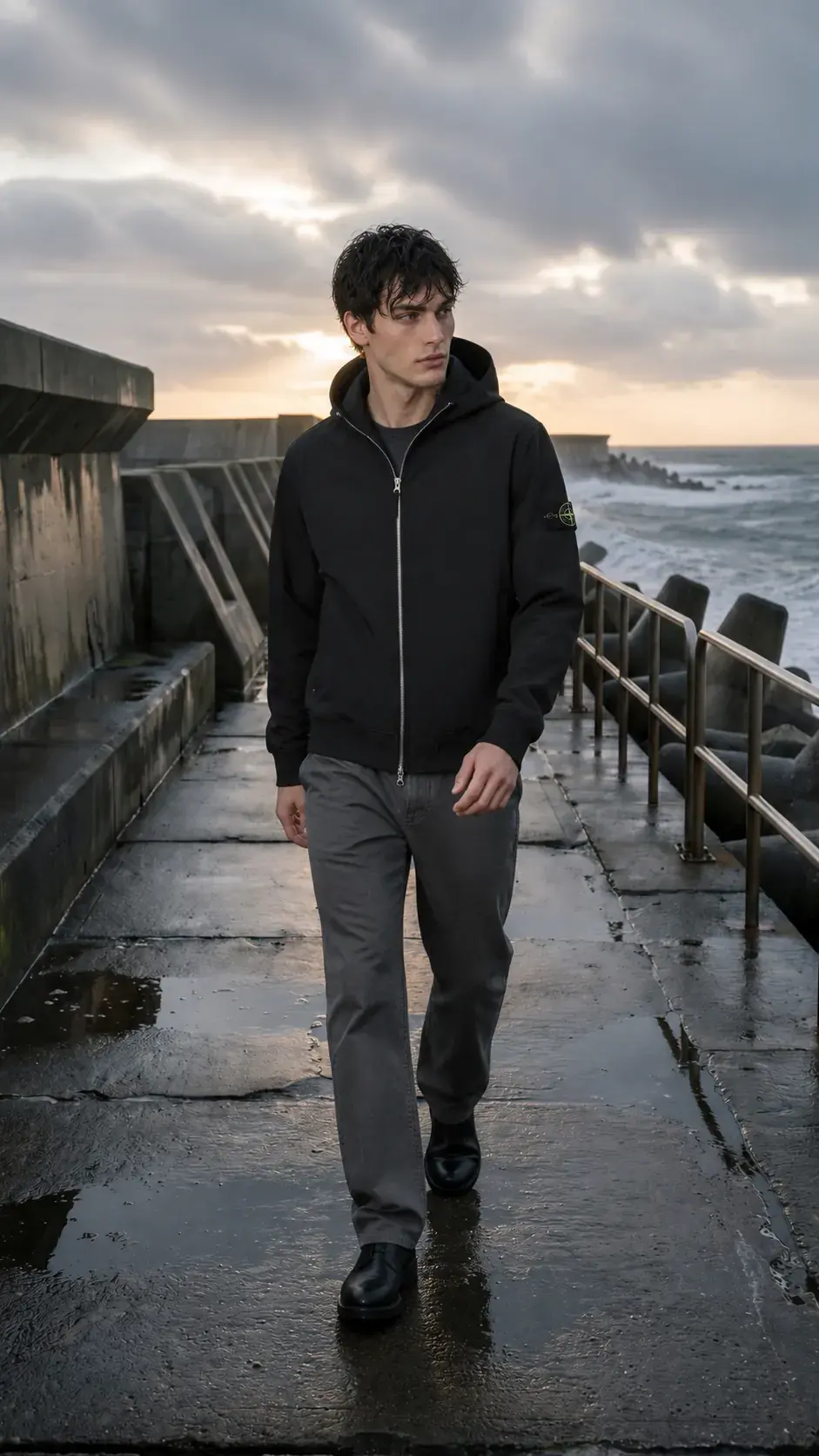 Anchor hero walk
 Close portrait
 Product / badge detail
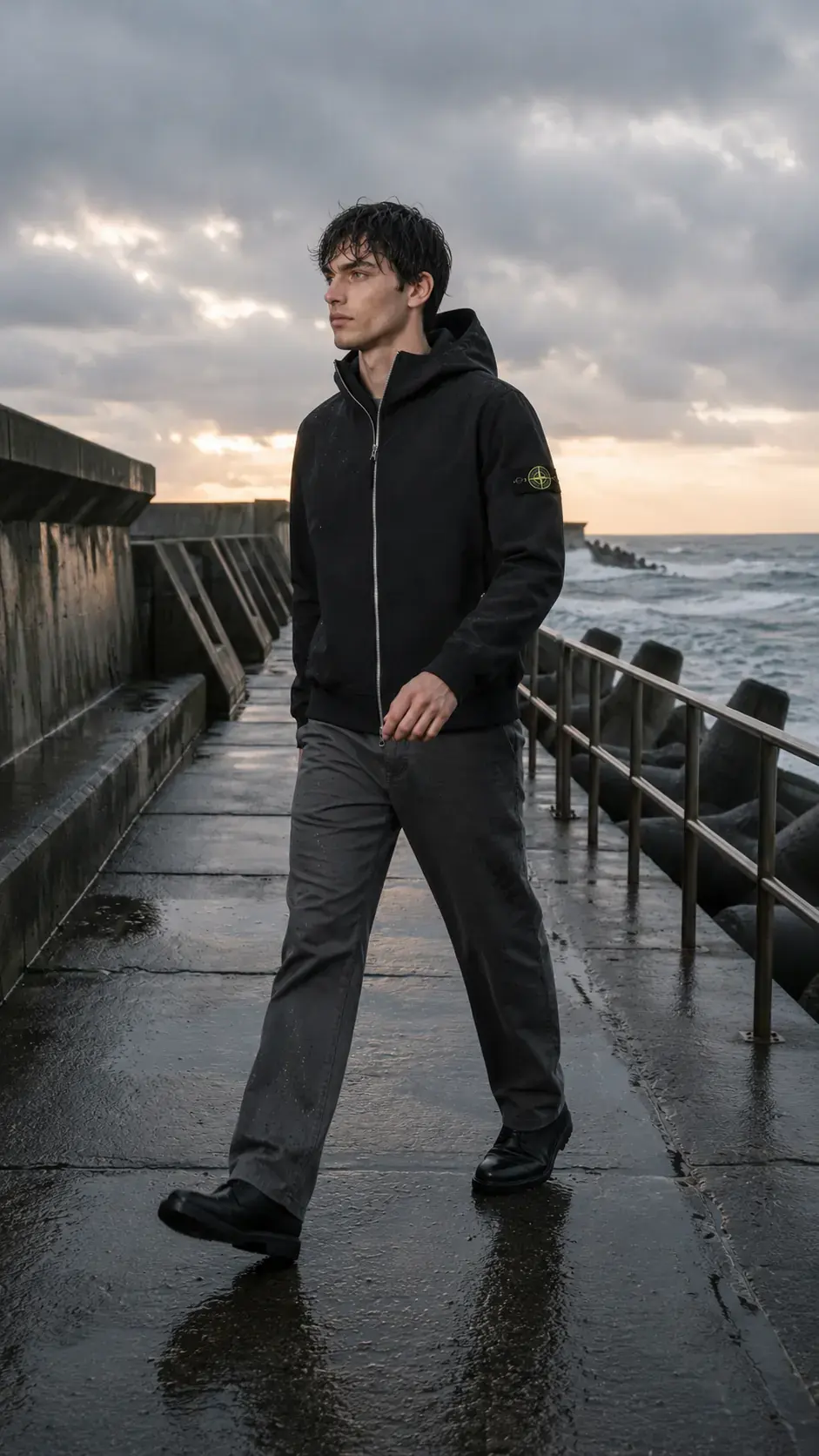 Side walk full-body
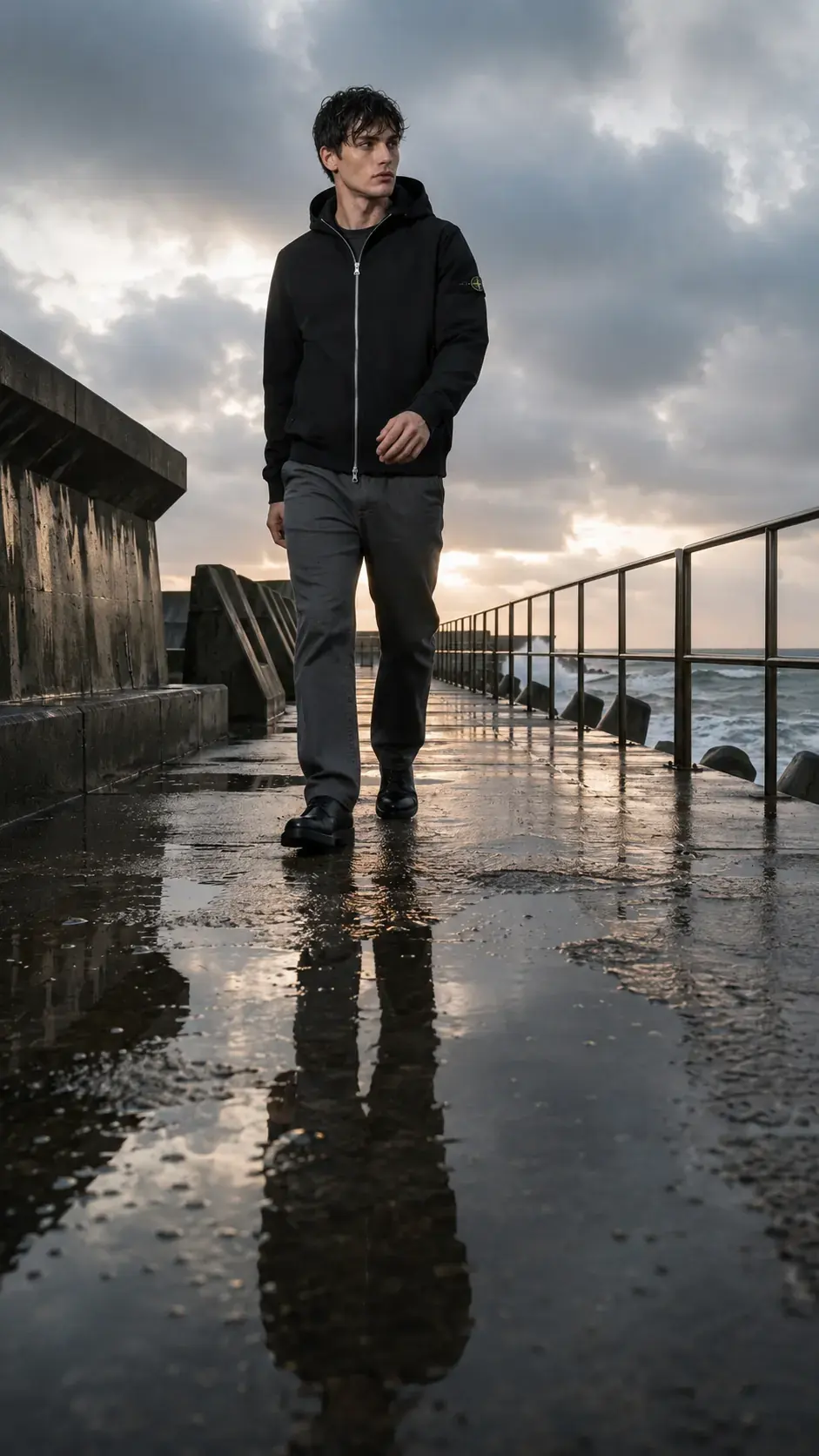 Wet reflection low angle
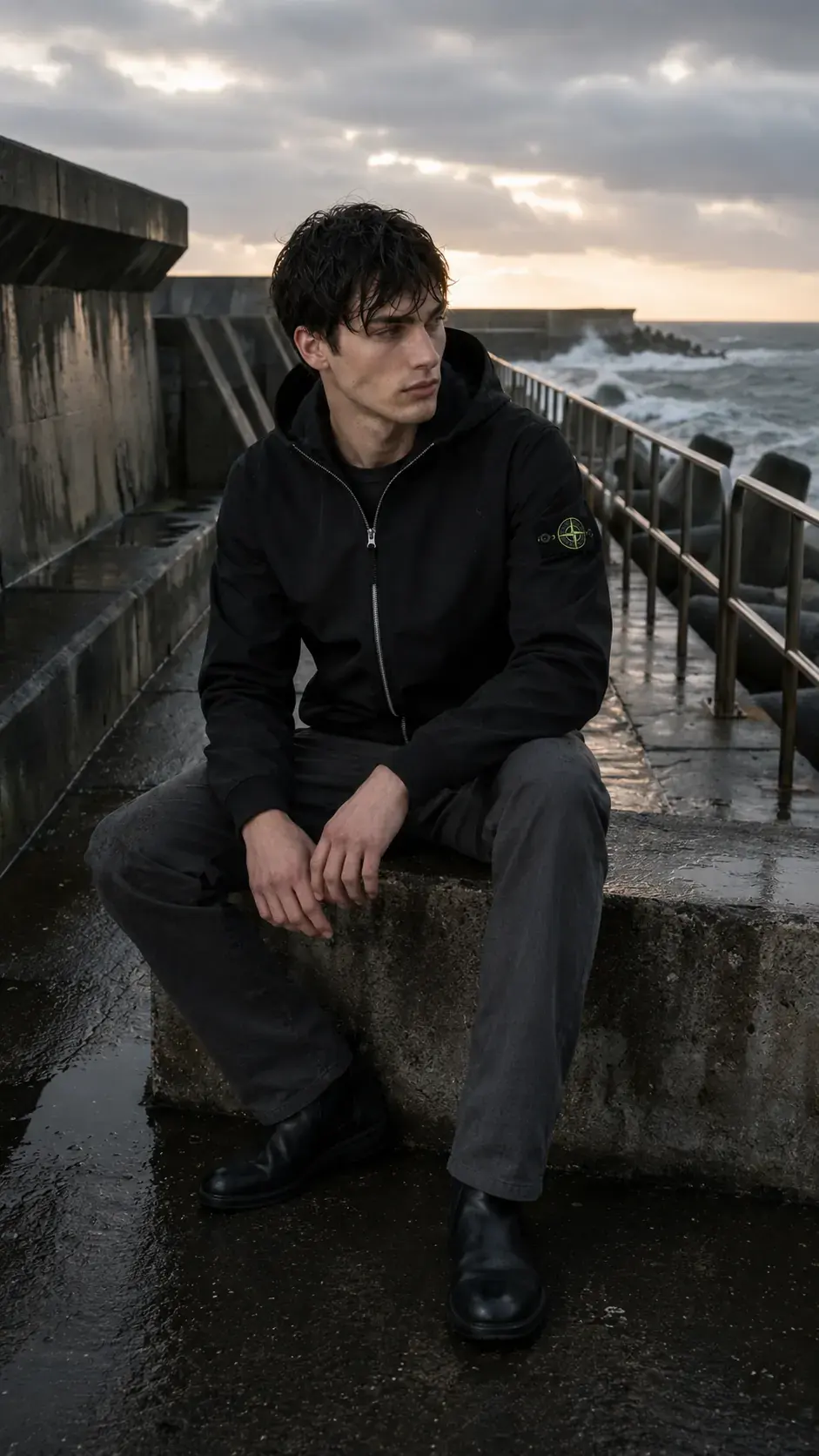 Seated editorial
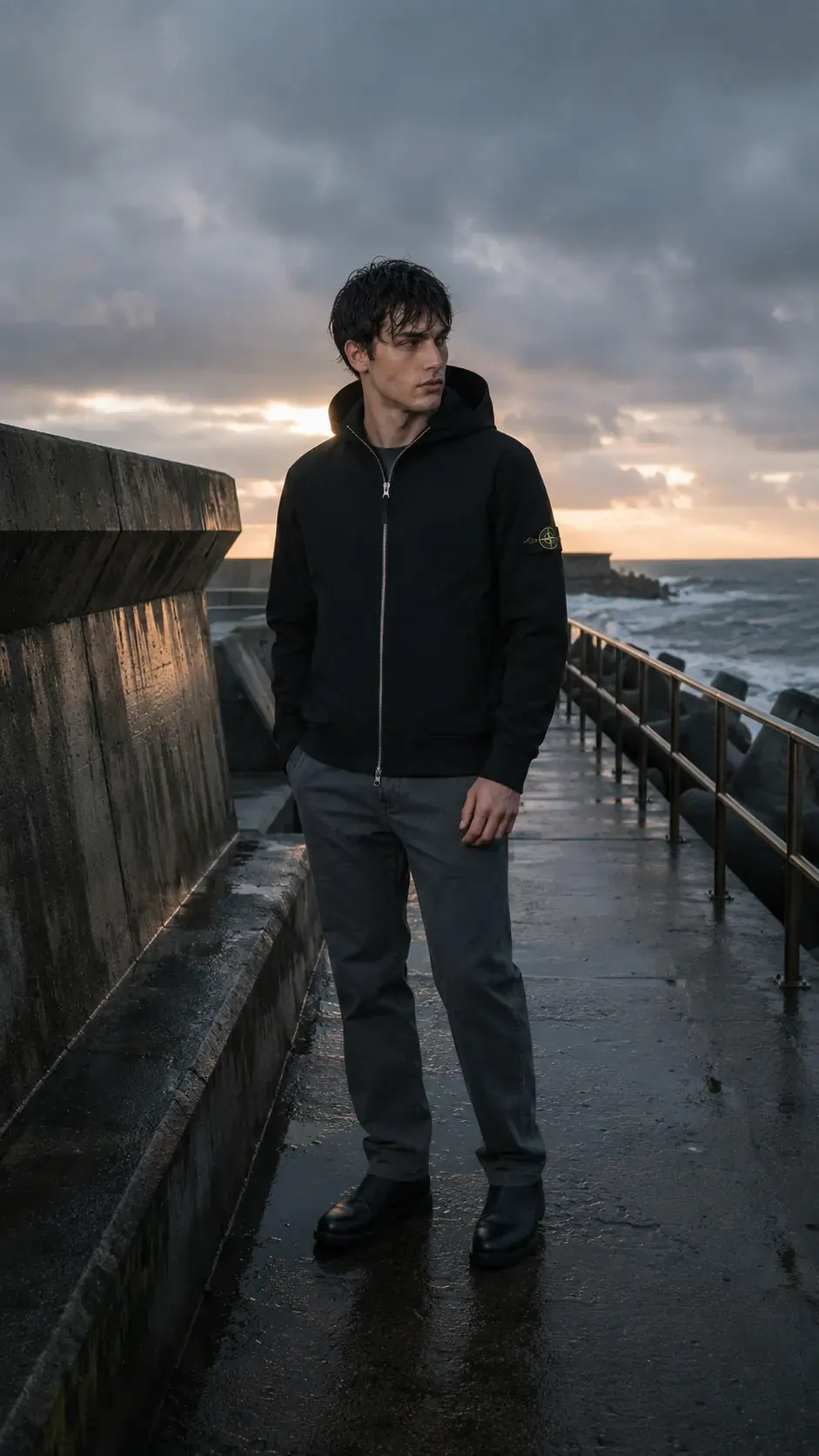 Final integrated hero
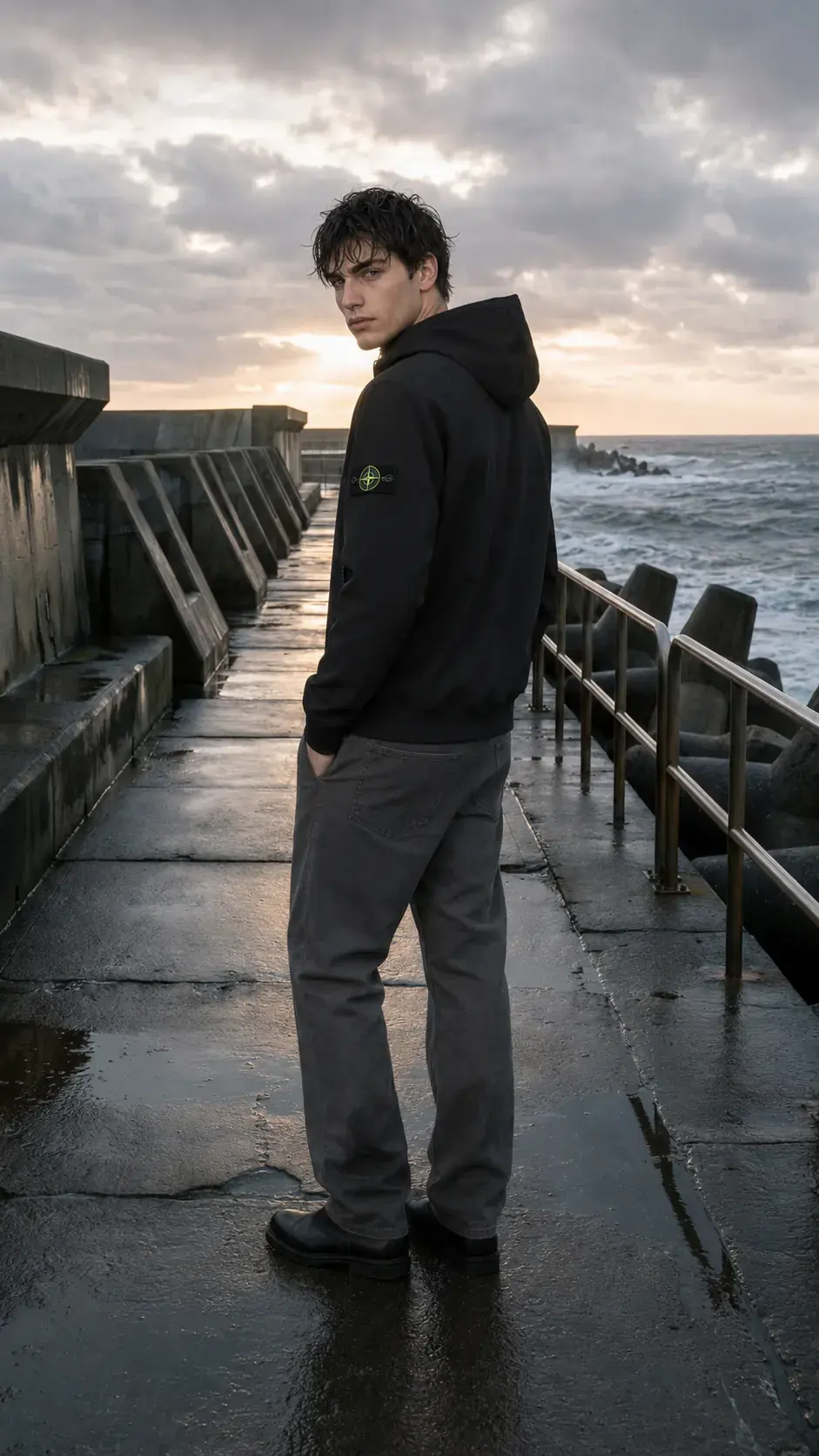 Sea look-back hero
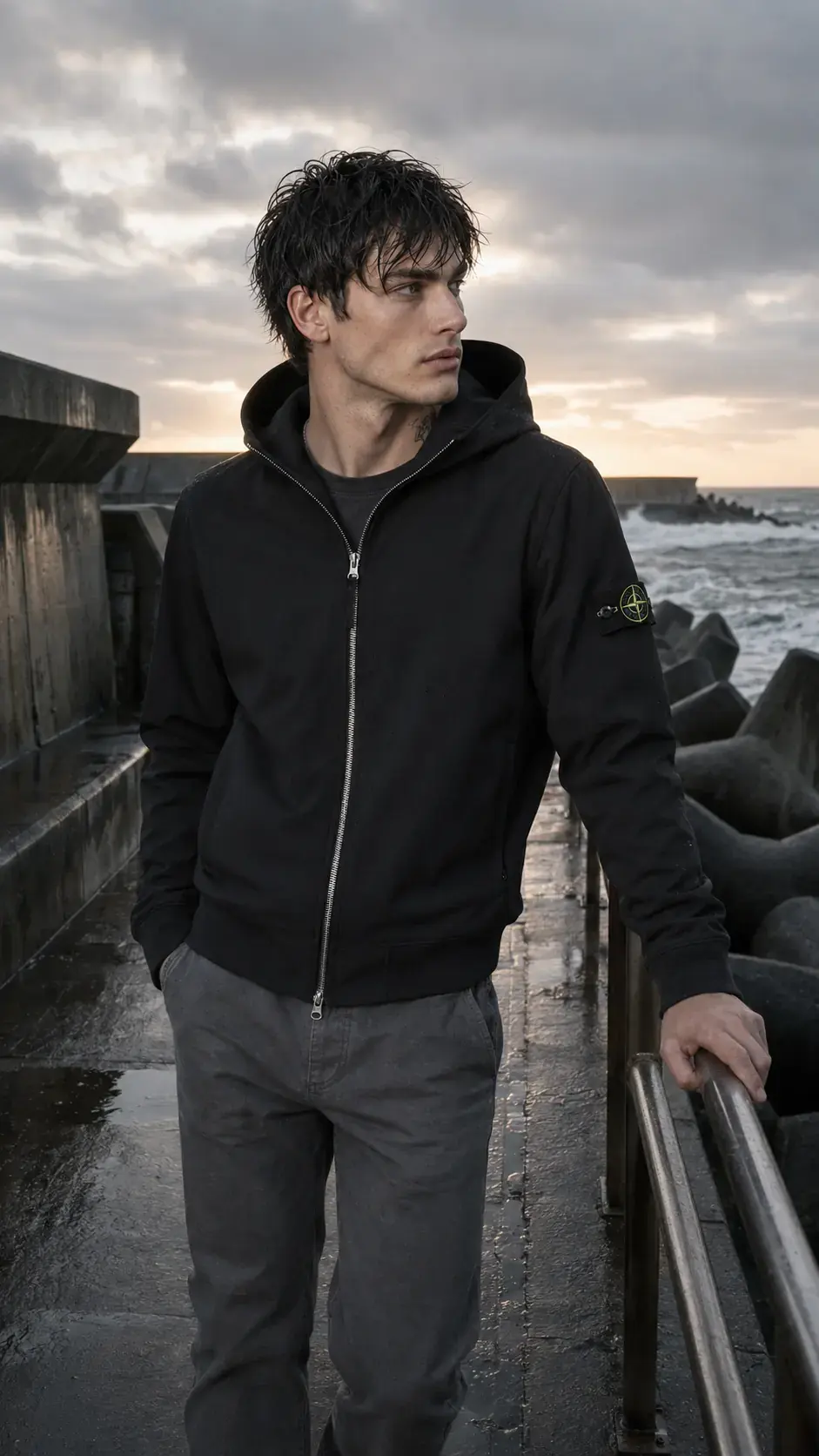 Rail contact profile
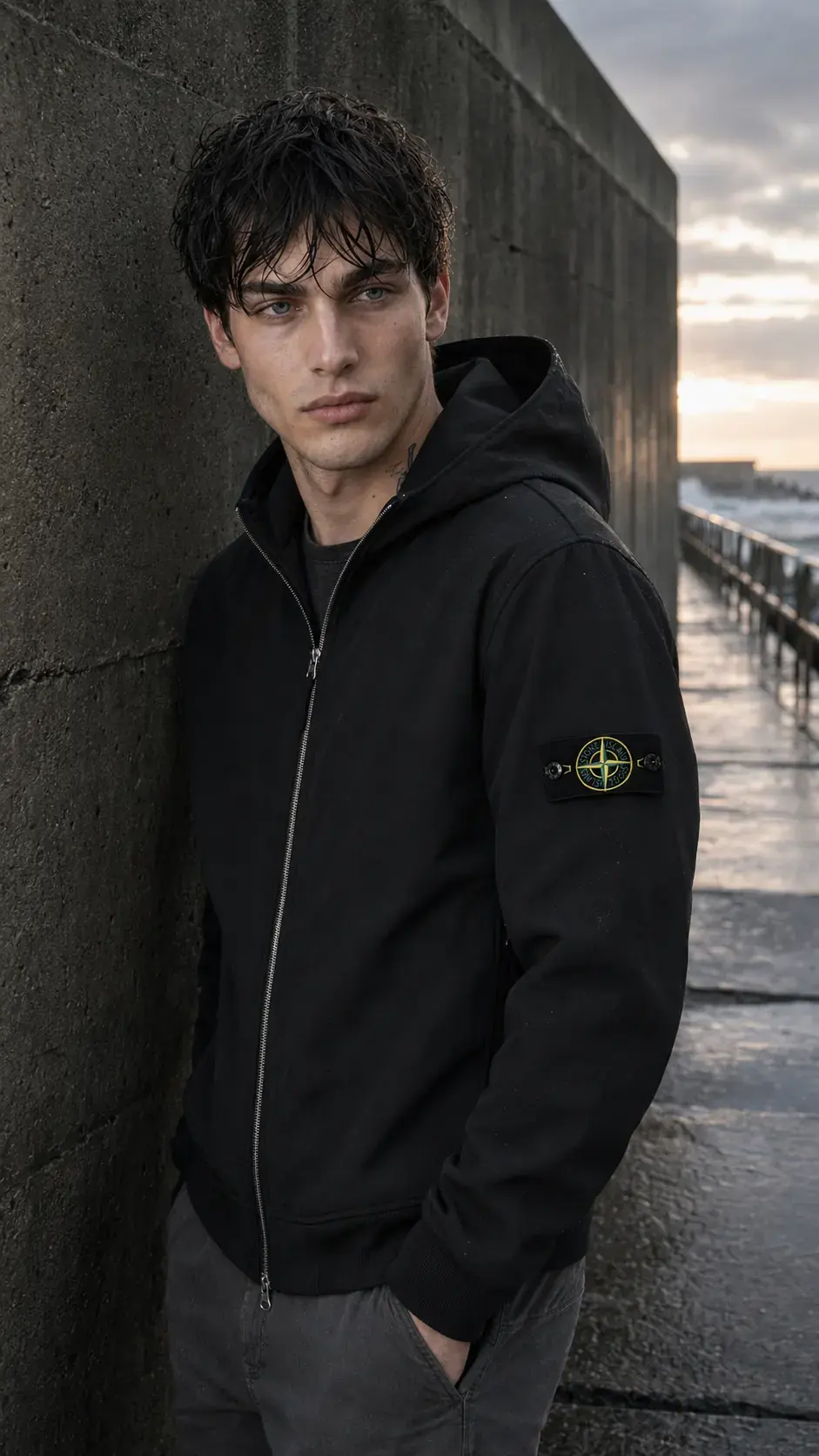 Concrete wall tension portrait
03 — The campaign stills
The full verbatim image and motion prompts are preserved inside expandable code blocks. Read the shot goal and reference setup before copying them.
01Campaign still 01
Build the first approved full-body frame that locks identity, garment, location and light.
Use the uploaded dark-haired male photograph as the sole and exact human identity anchor. Preserve his real identity without reinterpretation: the same forehead proportions, wet-textured dark hair, hairline, eyebrow density, light eye colour, eye shape, nose bridge and tip, cheekbone structure, natural lip volume, jawline, chin, ears, skin tone, neck proportions, visible neck tattoo position, and natural facial asymmetry.

Do not convert him into a generic male fashion model. Do not sharpen or widen his jaw, reduce his nose, enlarge his eyes, inflate his lips, erase the neck tattoo, add facial hair, change his age, change his eye colour, or create artificial facial symmetry. Preserve visible pores, faint beard-shadow texture, mild under-eye depth, small skin-tone variations, and individual damp hair strands.

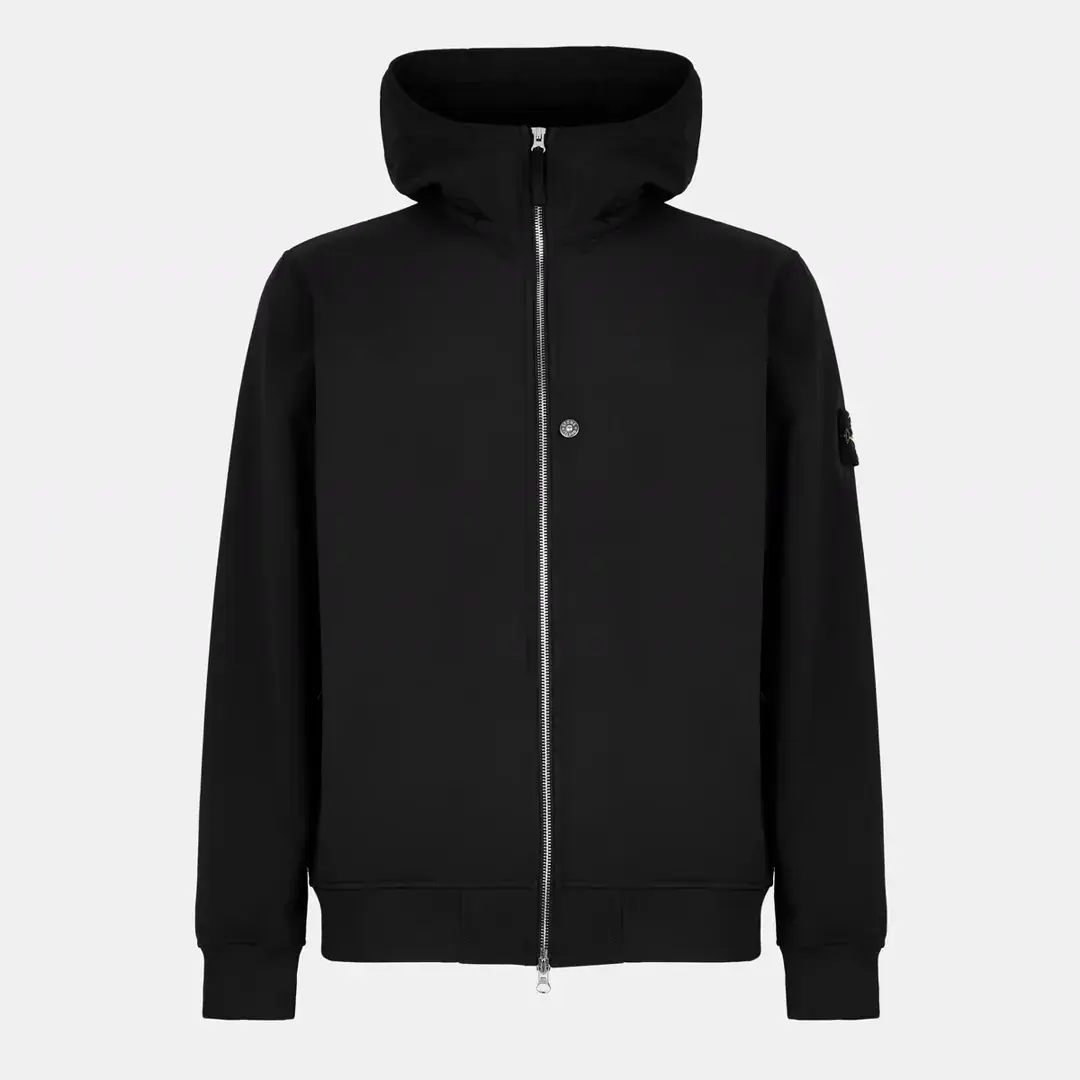
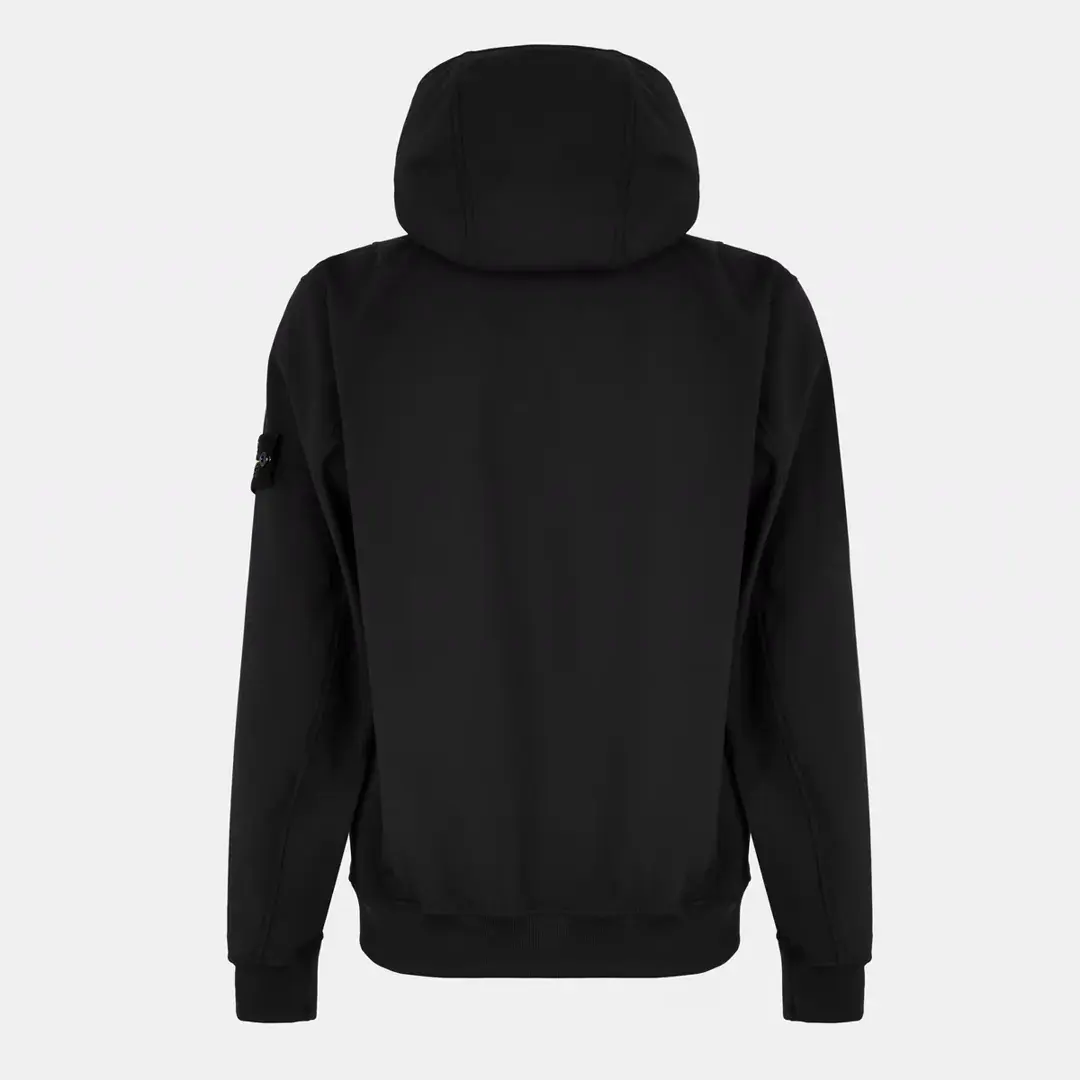
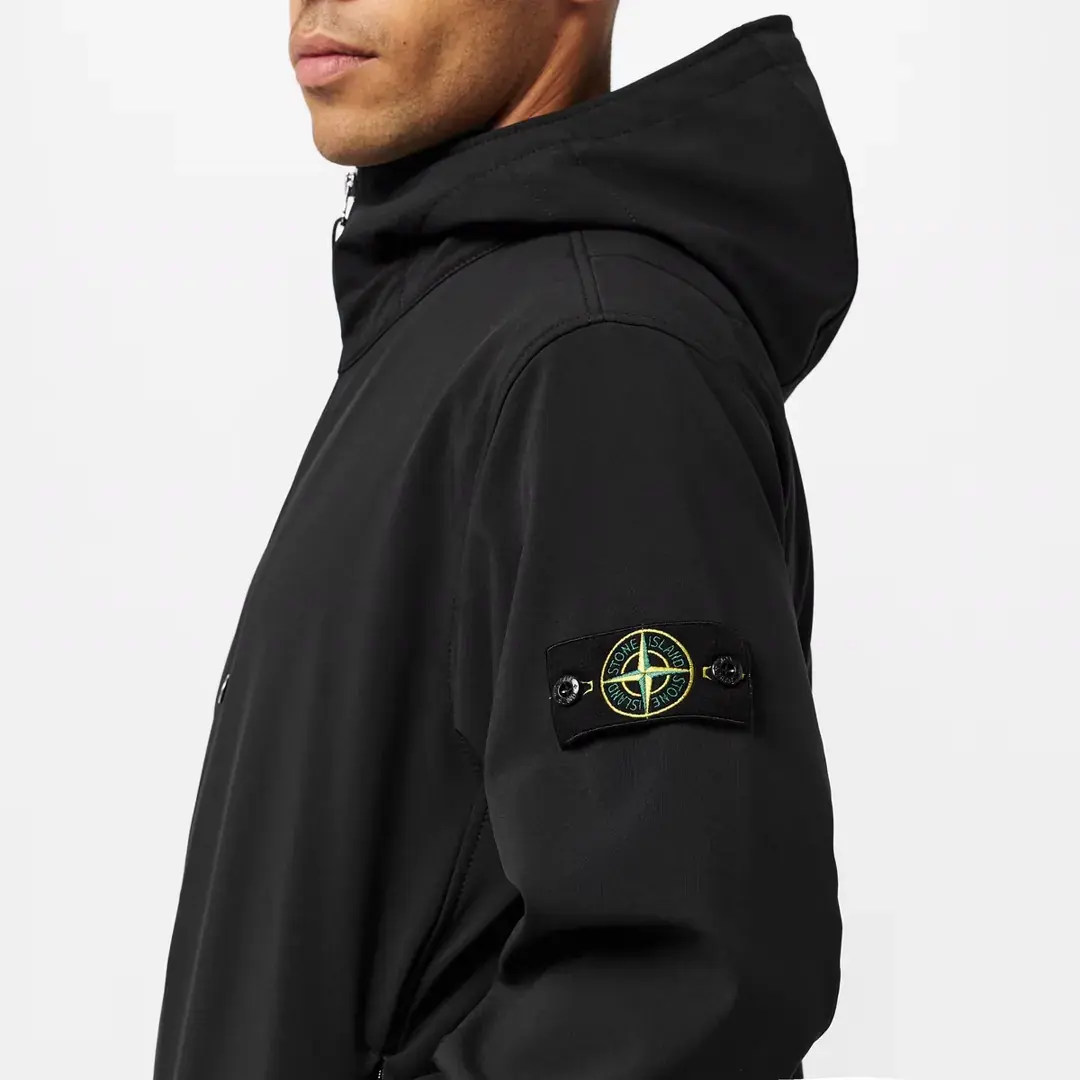
Use the three uploaded Stone Island jacket images as strict references to one exact physical garment. Reproduce the exact black hooded jacket shown in those references, not a similar jacket and not a newly designed technical shell.

The jacket must preserve all of the following construction details: deep neutral-black colour; smooth mostly matte technical soft-shell surface; regular straight body fit ending around the upper hip; large structured hood integrated into a high protective collar; full-length exposed silver-coloured central two-way zipper; small circular metal zipper-pull detail near the upper chest; rib-knit cuffs; rib-knit lower waistband; clean minimally panelled front torso; restrained rear construction; naturally shaped sleeves; and the authentic removable Stone Island badge attached with two black buttons at the exact upper-left-sleeve position and correct scale.

Do not change the jacket to grey, blue, navy, green, washed black, leather, nylon puffer, rain poncho, bomber jacket, parka, or oversized streetwear. Do not hide the silver central zipper, remove the ribbed hem, alter the hood, invent chest pockets, add visible flap pockets, add extra zippers, enlarge the badge, move the badge to the chest, mirror it onto the right sleeve, or duplicate it.

Keep the hood down behind the head in its natural structured shape. Keep the jacket zipped approximately eighty percent upward, allowing a narrow amount of the dark graphite crew-neck knit underneath to remain visible. The silver zipper must remain readable as a subtle vertical highlight.

The badge should retain the shape, black base, yellow-green compass motif, button attachment, position, and physical scale visible in the detail reference. Do not invent malformed pseudo-lettering. When exact lettering cannot be preserved, prioritise the correct physical badge design and placement; exact brand artwork can be restored during post-production.

Complete the fixed campaign wardrobe with washed graphite-grey straight-leg technical trousers and minimal matte-black low-profile leather shoes. The trousers must be visibly lighter than the black jacket so the outfit does not collapse into one dark silhouette. No bag, no hat, no gloves, no sunglasses, no necklace, no visible watch, and no additional accessories.

Use the supplied breakwater photograph as the exact location, architectural, perspective, weather, lighting, and colour-world anchor. Preserve the same long wet concrete path, heavy brutalist sea-defence walls on frame-left, stainless-steel railing on frame-right, wave breakers, rough grey-blue sea, low broken cloud layer, puddles, concrete seams, surface weathering, horizon position, and narrow warm opening in the clouds.

The man must exist physically inside this exact environment. Do not paste a separately photographed studio model over the background. His body, clothing, shadow, reflections, contrast, colour temperature, and atmospheric softness must agree with the location.

Create a vertical 9:16 primary campaign hero photograph of the man walking toward the camera along the wet breakwater path after the storm.

Position him slightly right of the walkway centre so the black jacket is primarily backed by the lighter reflective path, pale horizon, and sea rather than disappearing against the darkest concrete wall. Keep visible separation around both shoulders and the hood silhouette.

Place the man approximately nine metres from the camera. His full body must remain visible from head to shoes. He should occupy approximately fifty-three percent of the frame height, leaving meaningful wet walkway in front of him and clear architectural depth behind him.

Capture a genuine mid-stride moment. His left foot is planted slightly ahead and carries the body weight; the right heel is beginning to lift. His hips, knees, ankles, and shoulders respond naturally to the step. His torso is upright but not rigid. One shoulder sits fractionally forward because of the walking rhythm. His arms swing minimally and asymmetrically, with relaxed hands and naturally curved fingers. Do not pose both hands identically and do not place both arms perfectly straight against the body.

He looks several degrees past the camera toward frame-left with a calm, distant, self-contained expression. His lips are naturally closed. He is not staring into the lens, smiling, squinting dramatically, or performing a runway pose.

Coastal wind pushes the damp hair gently backward and slightly toward frame-right. Preserve several fine uncontrolled strands around the forehead and temples. The hood and jacket hem respond only slightly to the wind because the fabric has real weight. Do not create dramatic flying fabric.

Camera: full-frame photographic camera, vertical orientation, 65mm prime lens, camera height ninety-five centimetres above the wet ground, camera-to-subject distance approximately nine metres, aperture f/4.5, ISO 250, shutter speed 1/500 second. Maintain natural editorial compression, correct human proportions, sharp facial identity, and no wide-angle distortion.

The model and jacket remain optically sharp. The distant sea and architecture retain realistic detail with gentle atmospheric softening, not artificial portrait-mode blur. The environment must remain recognisable as the same master plate.

Lighting must solve the black-jacket separation realistically. Use the existing cool overcast sky as a broad soft frontal and upper fill source, preserving visible folds and panel transitions within the black fabric rather than crushing it into a flat silhouette. The narrow post-storm sunlight opening comes from high rear-left and produces a restrained warm edge highlight along the left side of the damp hair, hood, shoulder, upper sleeve, and parts of the silver zipper.

Use cool reflected light from the pale wet walkway and sea to reveal the front torso, sleeve folds, ribbed cuffs, ribbed waistband, and lower hood construction. The black jacket must remain genuinely black, but it must contain readable tonal steps from deep charcoal shadow to soft graphite highlight. Do not turn it grey merely to reveal detail.

Create physically correct grounding: soft contact shadows under both shoes, a slightly elongated diffused body shadow travelling toward frame-right, darker occlusion where the jacket overlaps the trousers, natural shadow beneath the hood, and subtle wet-ground reflection beneath the lower body. The reflection must be broken and irregular because of concrete seams, shallow puddles, and surface texture; it must not behave like a mirror.

Maintain the environment’s restrained editorial colour treatment: steel-blue sea, cool mineral-grey concrete, deep neutral jacket blacks, washed graphite trousers, subtly warm post-storm sunlight, natural skin, modest contrast, soft highlight roll-off, slightly reduced saturation, fine photographic grain, and no aggressive teal-and-orange separation.

Real-world imperfections must remain visible and restrained: damp hair clumping, several tiny rain beads on the hood and upper shoulders, subtle soft-shell surface sheen changes, small natural wrinkles at the elbows and waist, mild compression above the ribbed waistband, realistic trouser creasing at the hips and knees, faint moisture darkening near one trouser cuff, a few salt spots on the nearby railing, uneven puddle edges, slight concrete staining, and minor surface irregularities.

The result must feel like a real international technical-menswear campaign photographed on the existing breakwater immediately after rain: tactile, wind-exposed, slightly uncomfortable, physically grounded, visually restrained, and premium because of casting, garment detail, composition, and light rather than digital perfection.

No open hood on the head, no grey jacket, no blue jacket, no puffer jacket, no long parka, no oversized silhouette, no missing silver zipper, no missing ribbed cuffs, no missing ribbed hem, no additional pockets, no duplicated badge, no badge on the wrong sleeve, no fake oversized logo, no unreadable giant text, no plastic raincoat gloss, no flat crushed-black garment, no studio-lit subject, no perfectly symmetrical stride, no mannequin hands, no floating shoes, no perfect mirror reflection, no fantasy storm, no excessive water spray, no artificial HDR, no orange skin, and no CGI rendering.Animate the supplied vertical campaign still as one continuous three-second live-action fashion shot. Preserve the exact same dark-haired male identity, facial proportions, light eye colour, wet textured hairstyle, jawline, skin tone, neck tattoo placement, body proportions, black Stone Island hooded jacket, silver two-way zipper, left-sleeve badge, grey trousers, black shoes, wet brutalist breakwater, railings, sea, sky, lighting, and colour grade from the source image.
The man continues walking slowly and naturally toward the camera for approximately one controlled step. His front foot completes contact with the wet concrete while the rear foot lifts and moves forward naturally. Maintain anatomically correct hip, knee, ankle, shoulder, and arm movement. His arms swing only slightly and asymmetrically; his hands remain relaxed with correct fingers. He continues looking slightly past the camera toward frame-left rather than suddenly making eye contact.
The camera tracks backward at exactly the same slow speed as the model, maintaining nearly the same framing and subject scale. Use a smooth stable fashion-camera movement with no handheld shake, no sudden zoom, no orbit, and no acceleration.
Coastal wind moves only the loose ends of his wet hair and creates a very small natural response in the hood and jacket hem. The jacket has real weight and does not flap dramatically. Preserve the exact garment silhouette, zipper position, ribbed cuffs, ribbed waistband, hood shape, sleeve construction, and badge location. The badge must remain attached rigidly to the left sleeve; its design must not crawl, rotate, stretch, or transform.
The sea continues moving naturally in the background, with one restrained wave breaking against the distant sea defences. Small puddle reflections tremble very slightly from wind and nearby movement. Keep the environment geometry completely stable.
Maintain the source image’s cool post-storm ambient light and restrained warm sunset edge light. Do not brighten the face artificially and do not crush the jacket into featureless black.
No cuts, no scene transition, no slow-motion effect, no extra steps, no running, no exaggerated wind, no dramatic clothing movement, no face drift, no body morphing, no changing haircut, no mouth movement, no duplicated limbs, no floating feet, no sliding shoes, no badge deformation, no zipper deformation, no new pockets, no new logos, no background warping, and no artificial CGI motion.Campaign still 02
Prove the same identity and jacket survive a tighter portrait crop.
Use the uploaded male portrait as the exact human identity anchor, the three uploaded Stone Island images as strict references to the exact black hooded jacket, the supplied breakwater image as the location anchor, and the successful anchor hero as the campaign continuity reference.

Preserve the exact same man, jacket, wardrobe, hood-down state, eighty-percent zipper position, wet hairstyle, post-storm lighting, and colour treatment established in the anchor hero.

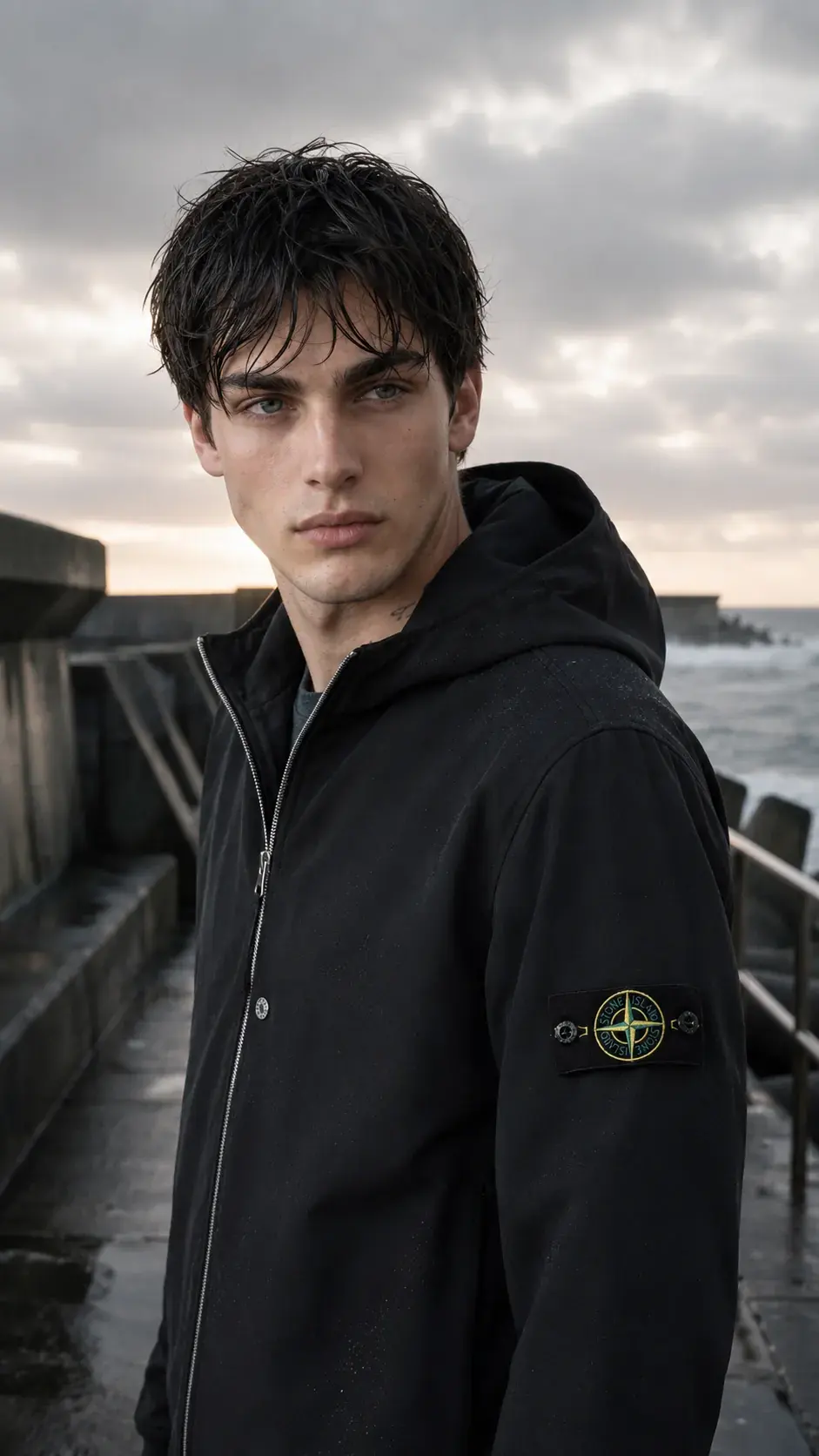
Create a vertical 9:16 close menswear campaign portrait framed from approximately the lower chest upward. The man stands on the same wet breakwater, body rotated around fifteen degrees away from the camera while his head turns slightly back toward the lens axis. He looks just beyond the camera with a calm, serious, emotionally contained expression.

Preserve his exact real facial anatomy, light eye colour, wet dark hair, skin texture, under-eye depth, neck tattoo placement, and natural asymmetry. Do not beautify, reshape, smooth, or replace him.

The uploaded jacket must remain exact: deep neutral-black soft-shell fabric, large structured hood resting down behind the head, integrated high collar, exposed silver central two-way zipper, ribbed cuffs and lower waistband when visible, clean torso, and the Stone Island badge at the correct left-upper-sleeve position and scale.

Compose the portrait so the black hood and shoulder are backed primarily by pale grey sky and desaturated sea, not by the darkest concrete wall. Allow the left sleeve and badge to rotate sufficiently toward the camera to remain recognisable without forcing an unnatural pose.

Camera: full-frame camera, 90mm prime lens, eye-level viewpoint, aperture f/4, ISO 250, shutter speed 1/400 second. Keep both eyes, face, damp hairline, collar, silver zipper, upper shoulder, and badge area sharp. Let the distant sea and concrete soften optically but remain identifiable.

Use broad cool post-storm ambient light to preserve facial structure and readable black-fabric tonal variation. Add the same restrained warm back-left edge light along the hair, hood, cheek contour, and shoulder. Retain natural cool fill from sea and wet concrete. Do not add studio rim lights or beauty lighting.

Maintain real imperfections: damp hair strands touching the forehead, tiny moisture beads on the hood and shoulder, pores, slight skin redness caused by wind, natural under-eye tone, minor collar asymmetry, soft fabric compression beneath the jaw, slight zipper waviness caused by the body, and restrained soft-shell sheen differences.

Keep the same steel-blue, wet-mineral, neutral-black post-storm grade as the anchor hero, with modest contrast, natural skin, soft highlight roll-off, fine grain, and no artificial HDR.

No different jacket, no hood worn up, no missing zipper, no leather appearance, no grey fabric, no oversized logo, no plastic skin, no cosmetics-ad finish, no perfect wet-hair styling, no artificial background blur, and no CGI material.Animate the supplied vertical close portrait as a single continuous three-second premium menswear campaign shot. Preserve the exact same male identity, facial proportions, light eyes, wet dark hair, skin texture, jawline, neck tattoo visibility, black Stone Island jacket, structured hood, silver zipper, left-sleeve badge, breakwater environment, sea, storm clouds, lighting, lens compression, and colour grade from the source frame.
The man remains nearly still. During the three seconds, he makes one subtle natural shift of attention: his eyes move a few degrees closer toward the camera axis while his head turns only two or three degrees, never becoming fully frontal. He performs one soft natural blink near the middle of the shot. His lips remain closed and completely still. His breathing produces only a tiny movement in the upper chest and collar.
Use an extremely slow, smooth camera push-in of only a few centimetres, preserving the original perspective and crop. Do not zoom digitally and do not change focal length. Keep the eyes, facial structure, hairline, zipper, shoulder, and badge area stable and sharp.
A light coastal breeze moves several individual damp hair strands near the forehead and temple. The larger hair shape must remain unchanged. The hood remains down and retains its exact structure. The black jacket stays heavy and mostly still, with only microscopic natural tension changes around the shoulder and collar.
The background sea moves gently and the distant wave foam shifts naturally. The railings and concrete architecture remain perfectly stable. Preserve the cool overcast ambient light with the subtle warm edge light from the original image.
No smile, no speech, no lip movement, no dramatic head turn, no direct aggressive stare, no face beautification, no eye-colour change, no skin smoothing, no changing jawline, no new facial hair, no hairstyle transformation, no badge movement, no zipper crawling, no fabric melting, no camera orbit, no parallax distortion, no background morphing, and no scene transition.Campaign still 03
Resolve material, zipper, water and sleeve-badge detail without turning the shot into ecommerce.
Use the uploaded male portrait as the identity reference, the uploaded front, back, and sleeve-detail images as strict references to the exact black Stone Island hooded jacket, the selected breakwater image as the environment reference, and the successful anchor hero as the continuity reference.

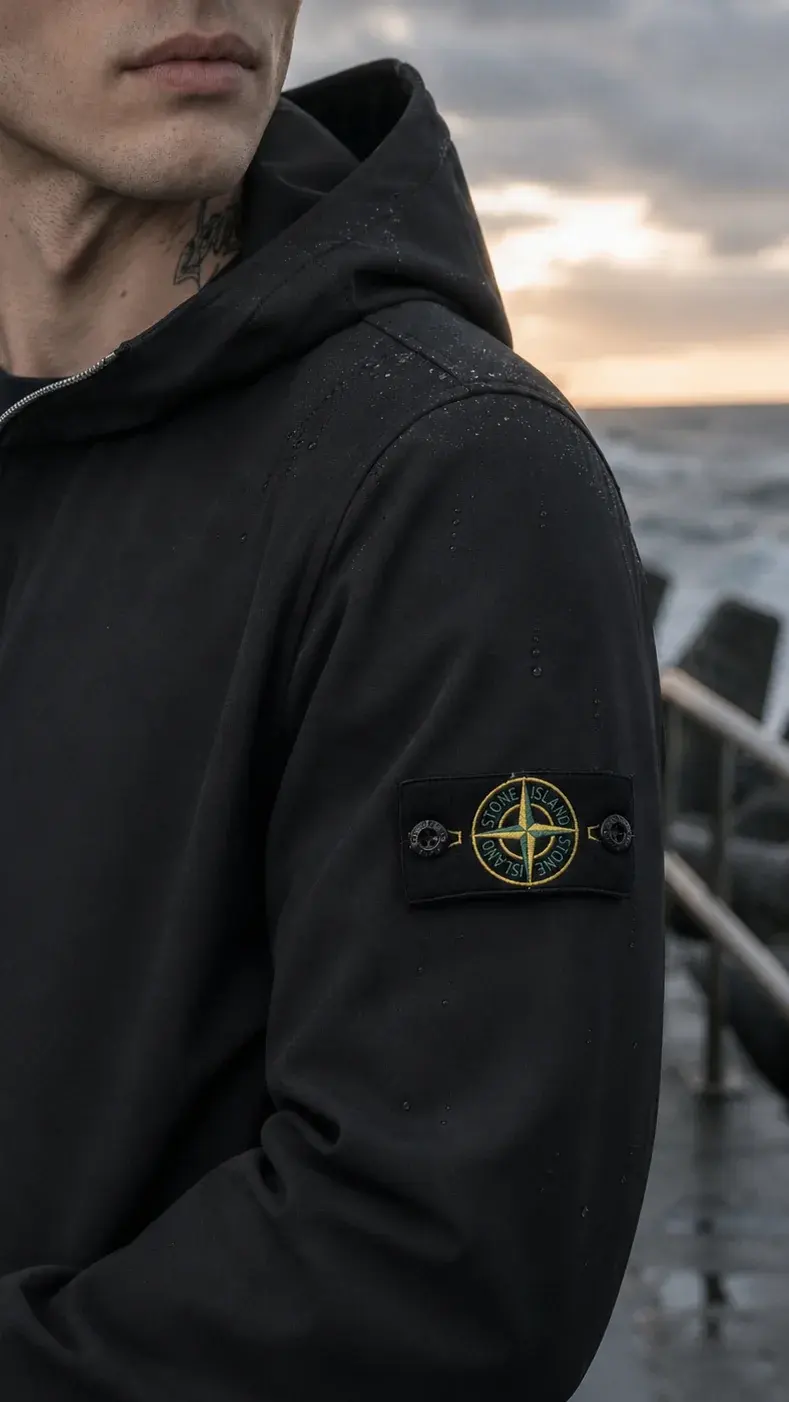
Create a premium vertical 4:5 on-body garment-detail campaign photograph showing the man’s lower jaw, neck, high collar, left shoulder, upper chest, upper left sleeve, and authentic sleeve-badge position.

Preserve the exact black jacket construction from the product references: smooth matte technical soft-shell surface, structured hood down behind the neck, integrated high collar, exposed silver central zipper, shoulder seam geometry, natural sleeve volume, and the black Stone Island badge attached to the left upper sleeve with two black buttons.

The badge must retain the correct black base, yellow-green compass motif, physical proportions, button positions, and distance from the shoulder and elbow shown in the uploaded detail image. Do not enlarge, relocate, mirror, or redesign it. Avoid malformed pseudo-lettering; accurate fine lettering may be restored in post-production.

The man is turned slightly away from the camera so the left upper sleeve comes naturally toward the lens. His left arm bends gently at the elbow, producing subtle real tension in the fabric without deliberately presenting the badge like a product demonstration.

Camera: full-frame camera with a 100mm macro lens, approximately eighty centimetres from the subject, aperture f/7.1, ISO 320, shutter speed 1/320 second. Keep the zipper teeth and pull, collar edge, shoulder seam, badge, button attachment, sleeve fabric, and selected moisture droplets sharply resolved. Allow the distant sea and concrete to fall away softly through real lens behaviour.

The fabric remains deep neutral black. Reveal it through controlled cool ambient reflection from the pale sky and wet concrete, not by lifting it to grey. A restrained warm rear-left edge light catches the hood edge, shoulder curve, several droplets, and a small part of the silver zipper.

Show only a sparse, irregular distribution of real water beads: several tiny droplets along the upper shoulder, two or three medium droplets on the upper sleeve, and slight damp tonal variation near a seam. Do not coat the entire jacket evenly in decorative water.

Preserve real material behaviour: fine matte surface grain, faint panel-direction sheen differences, natural seam waviness, mild fabric memory around the bent elbow, subtle zipper undulation, tiny fibres, minor dust particles, and non-uniform droplet shapes.

Keep the jaw and neck realistic where visible, including natural skin texture, slight cold redness, and correct neck-tattoo continuity. The breakwater remains only a soft contextual background.

No different badge, no extra branding, no grey jacket, no glossy plastic raincoat finish, no fake sprayed-water pattern, no invented seam network, no extra zippers, no visible mannequin effect, no hyper-sharpening, and no abstract CGI macro.Animate the supplied vertical garment-detail still as one continuous three-second luxury technical-fashion product shot. Preserve the exact male lower face, neck, neck tattoo placement, black hooded Stone Island jacket, matte soft-shell material, shoulder construction, hood shape, silver zipper, sleeve volume, water droplets, authentic left-sleeve badge, black buttons, wet breakwater, sea, lighting, focus falloff, and colour grade from the source image.
The subject remains almost completely still. His breathing creates a very slight, physically realistic rise and fall in the upper chest and collar. The bent sleeve shows a tiny corresponding change in fabric tension, but the arm does not change position.
The camera performs a slow, precise lateral slide of approximately three to five centimetres from frame-left toward frame-right, creating subtle premium parallax between the silver zipper, shoulder, badge, railing, and distant sea. Maintain the same macro-like lens compression. Do not orbit around the arm and do not reveal new garment areas.
Several tiny water beads on the shoulder and sleeve remain attached to the fabric. One very small droplet may travel a few millimetres downward along the sleeve under gravity, but the overall droplet pattern must remain stable and sparse. Do not make the jacket suddenly wetter.
Preserve the badge as a fixed physical patch attached to the left sleeve. The compass motif, rectangular black base, yellow-green embroidery, circular buttons, scale, orientation, stitching, and exact position must remain stable in every frame. The badge must not animate, ripple independently, rotate, resize, or produce changing letters.
A mild coastal breeze produces only a microscopic movement in the hood edge and one damp hair strand near the neck. The background sea and foam move gently while the concrete and railing remain locked.
No hand entering frame, no arm repositioning, no logo morphing, no fake animated embroidery, no changing text, no extra droplets, no glossy plastic transformation, no zipper bending, no added seams, no garment redesign, no face drift, no focus pumping, no dramatic rack focus, no handheld shake, no background reconstruction, and no cut.Campaign still 04
Change screen direction and stride while keeping the campaign world connected.
Production note: Recorded production prompt: this version says “cold grey to pale ice-blue” even though the approved garment and final output are black. For reuse, replace that phrase with “deep neutral-black” before generating.
Use the uploaded dark-haired male model as the exact identity anchor and preserve the same face, hair, skin, body proportions, and natural asymmetry established in the anchor hero. Keep the exact same outfit: the same cold grey to pale ice-blue technical jacket, black knit underlayer, dark charcoal straight-leg technical trousers, and minimal black shoes.

Use the supplied garment references and anchor hero as strict continuity anchors. Preserve the exact jacket fit, collar height, hood structure, sleeve construction, left-sleeve badge position, fabric surface quality, and overall technical feel.

Use the same brutalist seafront breakwater environment from the environment plate and anchor hero, preserving the same concrete language, wet surfaces, railings, sea, and weather atmosphere.

Create a premium vertical 9:16 full-body side-walking editorial image. The model is moving from left to right across frame along the edge of the breakwater, parallel to the sea. He is captured in a clean, natural walking stride with one foot stepping forward, coat hem and trouser fabric moving lightly in the coastal wind, and his upper body remaining composed. His gaze is directed ahead into the distance rather than at the camera. The sea, rail, and wet concrete should clearly locate him in the same post-storm environment.

Camera height is about 105 centimeters above the ground, using a full-frame 70mm-equivalent lens for elegant natural compression. Keep the full body visible with enough negative space around him for the architecture and sea to breathe. The image should feel like a real photographed campaign frame rather than a runway documentation shot.

Lighting stays consistent: cool overcast atmosphere with a ribbon of low warm sunlight striking one side of the jacket and the top edges of the concrete. Shadows stay soft and cool. Keep the exact same Kodak Vision3 250D-inspired editorial grading logic: cool mineral background, wet neutral blacks, slightly desaturated tones, gentle warm highlights, subtle grain, restrained contrast, and no fashion-commercial over-polish.

Believable realism details: slight wind deformation in the jacket body, natural wrinkles at the elbows and knees, damp hair movement, tiny wet specks on the walkway, mild splash residue on the lower trouser hem, and physically correct foot placement and shadowing. This must feel like a real luxury menswear campaign image shot outdoors in difficult weather, not a clean catalog full-body pose.

No exaggerated strut, no runway swing, no frozen mannequin pose, no floating feet, no distorted limbs, no random accessories, no bright lifestyle smile, and no synthetic magazine cutout look.Animate the supplied vertical full-body campaign still as one continuous three-second side-walking fashion shot. Preserve the exact same male identity, wet dark hairstyle, facial proportions, black Stone Island hooded jacket, silver zipper, left-sleeve badge, grey trousers, black shoes, wet breakwater, sea, railings, sky, lighting, and restrained post-storm grade from the source image.
The man continues walking naturally from frame-left toward frame-right and slightly forward along the breakwater. Complete approximately one smooth walking cycle during the full three seconds, never speeding up and never turning it into a runway strut. Preserve correct foot roll from heel to toe, realistic knee bend, hip rotation, shoulder counter-movement, and restrained natural arm swing.
His head stays mostly oriented toward the direction he is already looking. He may turn his gaze two or three degrees farther toward the sea, but he does not look into the camera. His facial expression stays calm and serious. His mouth remains closed.
The camera moves parallel to him at the same walking speed, preserving his scale and three-quarter profile. Use a smooth stabilized tracking movement with natural parallax in the railings and concrete structures. Do not orbit around him and do not move ahead of him.
The black jacket retains its exact construction and fit. The silver zipper remains straight and physically attached. The hood stays down. Wind produces restrained movement in the damp hair and a slight tension shift in the jacket body and hem. The left-sleeve badge stays fixed in position and shape.
Wet trouser fabric moves naturally at the knees and lower legs. The shoes maintain correct contact with the concrete without sliding. Reflections below the feet break and reform slightly as he crosses shallow wet areas.
Background waves and spray move naturally, while the architecture remains completely stable.
No face drift, no changing body proportions, no giant stride, no skating feet, no floating shoes, no leg crossing errors, no duplicated limbs, no hand deformation, no dramatic coat flapping, no badge morphing, no zipper distortion, no sudden camera zoom, no shake, no background warping, no cut, and no transition.Campaign still 05
Add a low camera position and broken reflection without losing body or garment continuity.
Use the uploaded dark-haired male model as the exact identity anchor and preserve the same identity, hairstyle, skin tone, facial structure, and body proportions from the anchor hero. Keep wardrobe continuity identical: the same technical jacket, black knit underlayer, dark charcoal trousers, and minimal black shoes.

Use the supplied jacket references and anchor hero as strict continuity anchors. Preserve the exact fabric construction, collar, hood, badge placement, and overall garment silhouette.

Use the same brutalist post-storm seafront environment and color language from the environment plate and anchor hero.

Create a premium vertical 9:16 low-angle editorial image built around wet-ground reflection. The camera is positioned approximately 25 to 30 centimeters above the ground near a shallow puddle on the concrete. The model is walking past or toward the camera so that both his real lower body and a broken, slightly distorted reflection of him appear in the wet surface. The reflection must feel physically believable, fragmented by ripples, uneven concrete, and puddle edges rather than acting like a perfect mirror. The full figure may be partially included, but the strongest emphasis is on the relationship between the garment, the stride, the wet ground, and the reflected silhouette.

Use a full-frame 50mm-equivalent lens from a low position. The shoes, lower trousers, and lower part of the jacket should feel grounded and real. The upper body and face may remain visible but not necessarily fully dominant. The sea and concrete structure should remain recognizable in the distance.

Lighting stays consistent with the campaign: cool storm-light ambience, with a low warm skim of sunlight catching the jacket edge, wet concrete, and parts of the reflected highlight. Maintain the same restrained Kodak Vision3 250D-inspired editorial grade: steel-blue sea, cool grey concrete, muted saturation, soft warm highlight accents, fine grain, modest contrast, and no hard glossy HDR reflections.

Realism details are crucial: small ripples in the puddle, micro speckling on the wet concrete, slight darkening of the trouser hem from moisture, realistic shoe contact with the ground, subtle deformations in the reflected shape, and believable fabric movement from walking and wind. The shot should feel tactile and cinematic but still photographically real, not like a stylized graphic trick.

No perfect mirror reflection, no floating feet, no giant puddle fantasy, no excessive motion blur, no distorted legs, no fake neon reflections, no CGI gloss, and no irrelevant objects.Animate the supplied low-angle vertical campaign still as one continuous three-second walking shot focused on the relationship between the model, wet concrete, and broken reflection. Preserve the exact same male identity, black Stone Island hooded jacket, silver zipper, left-sleeve badge, grey trousers, black shoes, body proportions, breakwater architecture, railings, rough sea, storm clouds, puddle geometry, lighting, and colour grade from the source image.
The man continues walking toward the camera for one slow controlled step. The forward shoe lands naturally on a damp but mostly solid section of concrete. The rear foot lifts and advances with correct ankle and knee mechanics. Do not make him step directly into a deep puddle and do not generate a large splash.
The camera tracks backward smoothly from the same very low height, keeping the model’s body and its elongated reflection aligned in the frame. Preserve the strong low-angle perspective without enlarging the shoes or stretching the legs. The camera remains level and stable.
As the foot contacts the wet ground, create only a few small realistic water displacements and tiny ripples. The reflection changes naturally with the step, broken by surface texture, seams, shallow water, and ripples. It must never become a perfect mirror image or a separate moving duplicate.
The model’s arms and shoulders respond subtly to walking. His gaze remains directed past the camera toward frame-left. Coastal wind moves the wet hair slightly backward. The hood and jacket hem react minimally because the fabric has real weight. Preserve the exact badge placement, zipper geometry, cuffs, waistband, and jacket silhouette.
The sea continues moving in the distance and one small wave breaks behind the railing. Maintain the source image’s cool post-storm light and warm reflection on the wet ground.
No large splash, no walking through deep water, no perfect mirrored clone, no delayed reflection, no reflection moving independently, no stretched legs, no oversized shoes, no sliding feet, no floating body, no face change, no garment redesign, no badge morphing, no zipper distortion, no camera tilt, no dramatic speed ramp, no cut, and no transition.Campaign still 06
Break the repeated standing pattern with a grounded editorial pause.
Production note: Recorded production prompt: “Stone Island-style” is less exact than the reference-lock language used elsewhere. For reuse, name the uploaded garment as the exact construction reference.
Use the uploaded dark-haired male model as the exact identity anchor and preserve the same face, jawline, hair texture, skin tone, proportions, and natural asymmetry from the anchor hero. Keep the same styling continuity: the same technical Stone Island-style jacket, black knit underlayer, dark charcoal straight-leg trousers, and minimal black shoes. Keep the jacket and all proportions identical to the product references and previous campaign images.
Use the supplied jacket references and anchor hero as strict continuity anchors. Preserve the exact fabric, collar, hood structure, sleeve shaping, left-sleeve badge position, and technical material character.
Use the same brutalist seafront environment, preserving the same wet concrete language, heavy architectural forms, railings, sea presence, and weather mood.
Create a premium vertical 9:16 seated editorial campaign image. The model sits on a large low concrete block or ledge within the breakwater environment. He leans slightly forward with forearms resting on his thighs or one elbow resting on one knee, maintaining a calm, serious, introspective expression. The pose must feel natural and unforced, as if paused during a walk after the storm, not like an artificial fashion contortion. The jacket should fold and compress naturally at the waist, elbows, and shoulders. The sea and concrete structures should remain visible behind him, reinforcing the environment.
Camera height is approximately 95 centimeters, using a full-frame 65mm-equivalent lens. The composition should show enough of the full body to read the trousers and shoes while still giving weight to the jacket and face. The shot should feel intimate but still clearly part of the same campaign world.
Lighting remains consistent: cool ambient sky light with a soft warm skim on one side of the face and jacket. The color treatment must match the rest of the series exactly: cool grey mineral palette, steel-blue sea, restrained warm highlights, neutral blacks, soft highlight rolloff, subtle grain, and no synthetic contrast or hyper-saturation.
Realism details: damp hair around the forehead, slight moisture on the jacket shell, natural fabric bunching at the elbows and knees, faint darkening where the concrete is wet, subtle shadow irregularities from the architectural forms, and the tactile feel of a real outdoor technical garment under wind and moisture. The image must feel like a high-end menswear editorial shot captured in a real location, not a studio portrait placed outside.
No theatrical pose, no crossed-fashion-editorial pose that feels contrived, no unnaturally clean concrete, no extra props, no readable text logos, no perfect polished skin, and no visual effects exaggeration.Animate the supplied seated vertical editorial still as one continuous three-second premium menswear campaign shot. Preserve the exact same male identity, facial anatomy, wet dark hair, skin tone, black Stone Island hooded jacket, silver zipper, left-sleeve badge, grey trousers, black shoes, seated body position, concrete block, wet breakwater, sea, railings, clouds, lighting, and colour grade from the source frame.
The man remains seated in the same relaxed forward-leaning posture. During the shot, he makes one very small natural adjustment: his upper body shifts slightly through his hips and one forearm settles a little more firmly onto the thigh. His hands remain visible and anatomically correct, with only subtle natural finger relaxation. He does not stand up, cross his legs, or radically change pose.
His gaze remains directed toward frame-left. Near the end of the shot, his eyes shift slightly farther toward the sea while the head turns no more than two degrees. His expression remains calm, distant, and serious. His lips remain still.
Use a slow controlled camera push-in combined with a very slight rightward slide, producing subtle parallax between his face, jacket, badge, railing, and sea. Maintain the same focal perspective and avoid dramatic orbiting.
Coastal wind moves a few wet hair strands around the forehead and temple. The hood remains down and stable. The jacket folds at the elbows, waist, and shoulders respond microscopically to breathing and the small posture adjustment. Preserve the exact badge, zipper, cuffs, ribbed hem, and black material.
Small water surfaces near the concrete block shimmer slightly. Distant waves and foam move naturally. Keep all architecture rigid and stable.
No standing motion, no large pose change, no extra hand gestures, no finger fusion, no direct look into camera, no smile, no speech, no mouth movement, no face drift, no body reshaping, no badge distortion, no jacket redesign, no artificial wind, no camera shake, no large orbit, no background warping, no scene transition, and no cut.Campaign still 07
Close the sequence with a resolved product, talent and environment hero.
Production note: Recorded production prompt: this version says “cold grey to pale ice-blue” even though the approved garment and final output are black. For reuse, replace that phrase with “deep neutral-black” before generating.
Use the uploaded dark-haired male model as the exact identity anchor and preserve his same real facial identity, skin tone, hair texture, face shape, jawline, eye shape, lips, neck tattoo visibility where naturally present, and natural asymmetry from the anchor hero. Keep his hair slightly wet and wind-affected, not freshly styled. Preserve realistic skin texture and do not beautify him into a different person.

Use the supplied technical jacket references and anchor hero as strict continuity anchors. Preserve the exact same cold grey to pale ice-blue technical jacket, high collar, hood structure, sleeve construction, concealed closure, left-sleeve badge position, and material character. Keep the same black knit underlayer, dark charcoal technical trousers, and minimal black shoes. Do not change the outfit or fit.

Use the same brutalist post-storm coastal environment established in the environment plate and anchor hero. The concrete, sea, railings, puddles, weathered surfaces, and post-storm light must all feel like the same exact campaign world.

Create the closing premium vertical 9:16 final hero image. The model stands near the edge of the breakwater or aligned with a major concrete wall and open sea behind him. He is static now, no longer walking, and the full image should feel like the strongest final campaign still. He stands in a calm, grounded stance with shoulders relaxed, one foot subtly forward, hands either relaxed by his sides or one lightly touching the jacket near the pocket or seam area. His expression is controlled, serious, and quietly confident. The jacket must read clearly as the hero product while the environment still contributes strongly to the mood.

Camera height is approximately 100 centimeters above the ground, using a full-frame 58mm-equivalent lens. The model should occupy roughly half the frame height, leaving meaningful environmental context. The composition must feel balanced and premium: character, garment, wet brutalist architecture, and sea all reading together in one unified frame.

Lighting is slightly later in the evening than the anchor shot: mostly cool post-storm ambient light with the last thin band of warm sun grazing one side of the jacket and face. The atmosphere should feel colder and more resolved. Maintain the same restrained editorial Kodak Vision3 250D-inspired grading: steel-blue sea, cool mineral concrete, wet neutral blacks, pale cold greys, soft warm highlight edges, modest contrast, fine grain, gentle highlight rolloff, and no cinematic overgrading.

Realism details must remain: slight dampness in the hair, small surface moisture on the jacket, subtle fabric memory folds, tiny salt dullness on nearby metal, shallow wet patches underfoot, and naturally imperfect architectural wear. The final result should feel like a real premium international fashion campaign hero image — sharp, controlled, tactile, weather-exposed, and believable — not a synthetic moodboard composite.

No smiley commercial attitude, no stiff mannequin posture, no giant logo graphic, no fake text, no fantasy storm sky, no oversaturated colors, no polished luxury-studio look, no CGI materials, and no unrelated props.Animate the supplied final vertical hero still as a restrained continuous three-second closing campaign shot. Preserve the exact same dark-haired male identity, facial proportions, wet hairstyle, skin tone, black Stone Island hooded jacket, silver zipper, left-sleeve badge, grey trousers, black shoes, standing posture, wet breakwater, concrete wall, railing, sea, storm clouds, sunset opening, reflections, lighting, and colour grade from the source image.
The man remains standing in the same grounded position. He does not begin walking. His body shows only natural breathing and a very slight shift of weight through the planted legs. One shoulder lowers by a nearly imperceptible amount as he relaxes. His hand position stays essentially unchanged.
During the final half of the shot, his head turns approximately two degrees farther toward the direction he is already looking. His gaze remains off-camera and serious. His expression does not change and his lips remain closed.
Use an extremely slow cinematic camera push-in, preserving the original composition and perspective. The movement should feel like a real stabilized dolly travelling only a few centimetres, not a digital zoom. Keep the model, jacket, badge, and zipper completely stable and sharp.
A low coastal breeze gently moves a few individual wet hair strands. The jacket remains heavy and controlled, with only a tiny natural response at the hood edge and lower hem. Preserve the exact black tone and tonal separation in the garment.
The distant sea continues moving, with a restrained wave breaking behind the concrete defences. The puddle and wet-ground highlights shimmer subtly. Storm clouds drift almost imperceptibly; do not create a time-lapse sky. Maintain the warm sunset break behind him and the cool ambient storm light.
No walking, no dramatic body movement, no direct eye contact, no blink if it risks facial drift, no smile, no speech, no face morphing, no changing jawline, no hairstyle transformation, no jacket colour change, no logo movement, no badge deformation, no zipper warping, no fake garment flutter, no camera orbit, no time-lapse clouds, no background reconstruction, no scene transition, and no cut.Campaign still 08
Use a back-facing composition while retaining identity and the left-sleeve product cue.
Use the uploaded dark-haired male model as the exact identity anchor, the uploaded black Stone Island jacket references as strict garment references, and the uploaded breakwater image as the exact environment world anchor.

Create a premium vertical 9:16 fashion campaign image set on the same wet post-storm brutalist coastal breakwater. Preserve the exact same man: same real facial identity, wet dark hair texture, light eye colour, face shape, jawline, nose, lips, ears, neck proportions, visible neck tattoo placement, skin tone, and natural facial asymmetry. Do not beautify him into a different person. Preserve realistic pores, faint under-eye depth, damp hair clumping, mild beard-shadow texture, and natural skin variation.

Preserve the exact same black Stone Island hooded jacket from the uploaded product references: deep neutral-black tone, structured hood resting down behind the head, integrated high collar, exposed silver central zipper, rib-knit cuffs, rib-knit waistband, smooth matte technical soft-shell surface, and authentic left-sleeve badge attached with two black buttons in the exact correct position and scale. Do not redesign the jacket. Do not change the badge placement. Keep the jacket zipped around eighty percent upward, with only a narrow dark graphite crew-neck layer visible underneath. Pair it with the same washed graphite-grey straight-leg trousers and minimal matte black low-profile leather shoes.

Use the same wet breakwater world as the environment anchor: long concrete path, large brutalist sea walls, railings, rough grey-blue sea, heavy broken cloud cover, small puddles, subtle weathering, and a narrow warm post-storm light opening in the sky. The model must feel physically present inside this exact place.

Create a three-quarter back-facing hero composition. The man stands near the right-side railing, body turned mostly away from camera toward the sea, while turning his head back over his left shoulder toward frame-left so part of his face remains visible in a calm, distant, serious expression. He is not smiling and not staring aggressively into the lens. His left shoulder is slightly closer to camera so the left-sleeve badge remains visible without looking artificially presented. One hand rests loosely in a trouser pocket; the other arm hangs relaxed.

The emotional tone is reflective, self-contained, wind-exposed, premium, and slightly cold. Coastal wind pushes several damp hair strands backward and slightly sideways. The hood and jacket hem respond only minimally because the fabric has real weight. Keep the body grounded and anatomically correct.

Camera and image treatment: full-frame camera, 85mm lens, camera height around chest level, moderate distance, f/4.5, realistic optical depth, no exaggerated blur. Use cool overcast ambient light with a restrained warm sunset edge light from behind, creating a subtle rim along the hood, cheek, and shoulder. Maintain readable tonal variation inside the black jacket without turning it grey. Keep the sea, railings, and concrete recognisable. Preserve natural wet-surface reflections and soft broken highlight rolloff.

Include restrained real-world imperfections: uneven damp patches on concrete, tiny water beads on the shoulder and hood, mild wrinkle tension at elbows and waist, slightly wind-disordered hair strands, faint moisture darkening near one trouser cuff, subtle salt staining on the railing, and irregular puddle edges. The result must feel like a real luxury technical-menswear campaign photograph, not a perfect CGI render.

No different man, no hood up, no changed jacket design, no extra pockets, no missing zipper, no badge on the wrong sleeve, no duplicated badge, no oversized logo, no dramatic pose, no runway attitude, no excessive wind, no fantasy storm, no fake water spray, no overdone teal-orange grade, and no plastic skin. Animate this still as a continuous three-second premium fashion shot. Preserve the exact same male identity, black Stone Island jacket, badge placement, wet breakwater, sea, railings, lighting, and colour grade.
The man remains mostly still, facing the sea. During the shot, he slowly turns his head a few more degrees back over his shoulder toward the camera axis while keeping a calm, serious expression. One soft natural blink occurs once. A light coastal breeze moves a few damp hair strands and creates a tiny natural response in the hood edge and jacket hem. The hand in the pocket stays stable.
Use a very slow smooth camera push-in with a slight lateral slide, creating subtle parallax between the model, railing, and sea. The sea continues moving gently and one distant wave breaks softly. Preserve the black jacket silhouette and keep the badge rigid and unchanged.
No dramatic body movement, no smile, no speech, no face drift, no jacket redesign, no badge morphing, no zipper deformation, no background warping, no camera shake, and no cut.Campaign still 09
Create tactile contact with the location and controlled profile movement.
Use the uploaded dark-haired male model as the exact identity anchor, the uploaded black Stone Island jacket references as strict garment references, and the uploaded breakwater image as the exact environment world anchor.

Create a premium vertical 9:16 fashion campaign image in the same post-storm breakwater location. Preserve the exact same male identity, facial structure, wet dark hair, light eye colour, neck tattoo placement, skin tone, and natural asymmetry. Do not change him into a different model and do not over-retouch the face.

Preserve the exact same black Stone Island hooded jacket: deep neutral-black colour, smooth matte technical soft-shell feel, structured hood worn down, high collar, exposed silver front zipper, rib-knit cuffs, rib-knit waistband, correct left-sleeve badge with two black buttons, correct badge scale and placement, and same overall regular fit. Keep the jacket about eighty percent zipped. Preserve the same graphite-grey trousers and matte black low-profile shoes.

Set the image on the same wet brutalist coastal breakwater with heavy sea walls, wet concrete, steel railing, rough ocean, dark cloud cover, and a restrained warm opening in the sky after rain. The model stands beside the railing in a strong side-profile / three-quarter side composition. He lightly places one hand on the cold metal railing while the other hand remains relaxed near the thigh or partly inside a trouser pocket. His torso faces partly toward the sea, and his head stays in profile, gazing outward toward the horizon rather than toward the camera. The expression is calm, contemplative, and emotionally controlled.

The pose must feel natural, as if he has paused during a solitary walk after the storm. Keep the body anatomically correct and relaxed. Avoid stylised runway posing. The left sleeve should angle naturally enough that the badge remains visible but not obviously “shown off.”

Camera treatment: full-frame camera, 70mm lens, eye-level to slightly above waist-level viewpoint, f/4.8, realistic perspective, no wide-angle distortion. Use soft cool ambient storm light with a narrow warm side-back rim from the clearing sky. Preserve tonal detail in the black jacket through cool reflection from the sea and wet concrete. The railing and sea should create depth and subtle leading lines.

Real-world imperfections should remain: tiny droplets on the shoulder and sleeve, mild dampness on the jacket surface, slightly clumped wet hair, small wrinkles at the elbow and lower torso, irregular puddle reflections, subtle salt marks on the railing, and natural weathered stains on the concrete walls. Keep the colour treatment restrained and premium: cool steel-blue sea, mineral grey concrete, natural skin, deep true black jacket, graphite trousers, and modest warm sunset accents. The result must feel like a real luxury campaign still shot on location, not a synthetic fashion render.

No hood up, no different outfit, no extra layers, no floating hand, no badge distortion, no missing zipper, no exaggerated pose, no dramatic flare, no fake storm spray, no smiling, no artificial symmetry, and no CGI-perfect surfaces. Animate this still as a continuous three-second luxury fashion shot. Preserve the exact same male identity, outfit, jacket, badge placement, railing, sea, concrete, lighting, and colour treatment.
The man remains paused by the railing. He slowly shifts a small amount of weight into the arm touching the rail, and his head turns a few degrees farther toward the sea. His expression remains serious and calm. One light gust moves several damp hair strands and creates a minimal natural tension change in the hood and jacket body. The hand touching the railing stays physically grounded.
The camera performs a smooth, subtle sideways slide parallel to the railing, creating elegant parallax in the rail, sea, and concrete walls. The ocean continues moving naturally and one distant wave rolls through the background. Preserve the badge as a rigid fixed patch and keep the zipper stable.
No smile, no speech, no dramatic pose change, no face morphing, no hand deformation, no garment redesign, no badge movement, no zipper crawling, no background warping, no heavy camera shake, and no scene cut.Campaign still 10
Use the heavy wall as an intimate portrait device without separating the model from the campaign.
Use the uploaded dark-haired male model as the exact identity anchor, the uploaded black Stone Island jacket references as strict garment references, and the uploaded breakwater image as the exact environment world anchor.

Create a premium vertical 9:16 close-to-medium editorial fashion portrait in the same wet brutalist breakwater world after rain. Preserve the exact same man with the same real face, wet dark hair texture, eye shape and colour, jawline, lips, nose, ears, skin tone, neck tattoo placement, and natural asymmetry. Preserve real pores, slight under-eye depth, damp hair clumping, mild beard-shadow texture, and natural skin colour variation. Do not beautify him into another person.

Preserve the exact same black Stone Island hooded jacket from the product references: deep true-black tone, smooth mostly matte technical soft-shell character, structured hood resting down behind the head, integrated high collar, exposed silver zipper, rib-knit cuffs and waistband when visible, and the authentic left-sleeve badge in the correct exact position and size. Keep the jacket around eighty percent zipped, with a very small amount of dark graphite underlayer visible at the neck. Preserve the same grey trousers if lower body appears.

Stage him close to the large wet concrete wall on the breakwater, using the wall as a heavy architectural backdrop. He stands or lightly leans near the wall with his body turned about thirty degrees away from the camera, while his face turns slightly back toward the lens axis but not fully frontal. The expression is restrained, introspective, serious, and slightly cold. He is not smiling and not performing a fashion “attitude” cliché. One shoulder can sit a little closer to the concrete to create tension and intimacy.

Frame from approximately upper thigh or waist upward, prioritising face, hood, collar, shoulder, and left sleeve. The wall should occupy a strong part of the left side of the frame, while the right side opens subtly toward the sea and railing in softer background focus. This should feel like a real editorial portrait shot in a harsh coastal environment.

Camera and image treatment: full-frame camera, 90mm lens, moderate portrait compression, f/4, natural optical background softness. Use cool diffuse post-storm ambient light as the base, with a restrained warm edge light from the clearing sunset catching hair edges, hood edge, and cheek contour. Keep the jacket black but readable through soft reflected light from the wet ground and sky. Maintain a premium, muted, slightly desaturated grade with soft highlight rolloff and no artificial HDR.

Preserve real-world imperfections: small water droplets on the hood and shoulder, tiny damp specks on the chest, soft uneven moisture on the concrete wall, subtle fabric tension near the shoulder seam, minor zipper waviness, irregular hair strands on the forehead and temple, and slight wind-chill redness in the skin. The overall mood should be intimate, cinematic, premium, realistic, and physically grounded.

No direct fashion-magazine glam retouching, no smiling, no hood up, no changed jacket silhouette, no extra logos, no missing badge, no badge relocation, no plastic skin, no fantasy lighting, no exaggerated shallow depth-of-field, and no CGI rendering. Animate this still as a continuous three-second editorial portrait shot. Preserve the exact same male identity, black Stone Island jacket, badge, concrete wall, sea context, lighting, and colour grade.
The man remains almost still near the wall. He performs one subtle micro-turn of the head a few degrees closer toward camera and one soft natural blink. His upper chest rises slightly with breathing. A small coastal breeze moves a few damp hair strands and creates minimal tension changes around the hood edge and shoulder. The jacket remains heavy and controlled.
Use a slow, smooth cinematic push-in with almost no shake. Keep facial identity, collar, zipper, shoulder, and badge stable and sharp. The background sea moves softly and the distant light flickers subtly through clouds, while the wall remains rigid and unchanged.
No smile, no speech, no large pose change, no face drift, no beautification change, no badge morphing, no zipper distortion, no background warping, no sudden camera move, and no cut.04 — Motion control
Kling settings: 3 seconds, 1080p master, vertical input, one approved still, restrained motion.
Each shot asks for one controlled step, a small head turn, one natural blink, a slight camera push or a minimal body-weight shift. The motion prompt protects the frame before it describes movement.
A three-second generation does not have to survive intact. The final edit keeps only the strongest stable frames from each clip.
05 — Edit structure
Introduce the identity source.
Establish the campaign world.
Show the physical garment reference.
Use only the stable section of each generation.
Hold long enough for the campaign to resolve.
06 — Failure points
Use different views of the exact same garment and colourway. Similar products introduce conflicting construction.
Separate the garment with pale sky, sea and wet-ground fill. Preserve tonal steps without changing black into grey.
Large movements invite face drift, incorrect hands, sliding feet and garment deformation. Assign one dominant action.
Wet concrete breaks reflections through seams, texture, shallow water and wind. A clean mirror looks synthetic.
Small high-information details remain fragile. Use a close reference and repair exact artwork in post when needed.
Believability comes from restrained imperfection: damp hair, uneven droplets, fabric compression, salt marks and optical softness.
Learn the system
The Academy connects references, identity, products, first frames, motion, editing and commercial delivery.
Explore AI Craft AcademyBuild one for your brand
Share your product references, objective, formats and visual direction with AI Craft Studio.
Start a project